
Try it while the kettle heats. Lift one foot an inch off the floor, hands at your sides, and count. If you are thirty, the exercise is boring, and you will quit from impatience long before you wobble. Somewhere in the middle decades it stops being boring. The ankle starts making small urgent corrections, the arms drift outward on their own, and a skill you have owned since you were a toddler reveals that it has been quietly leaving without giving notice. Nobody feels balance fade. It does not ache, it does not announce itself, and there is no moment when it is obviously gone. There is just, eventually, a curb, a ladder, a patch of ice, and a body that no longer catches itself the way it used to. The good news is waiting in the same place as the bad: this is a sense, senses dim with disuse, and this one answers training in any decade of a life.
The Sense Without a Name
Balance does not get counted among the five senses, but it is one, stitched together from three streams of information that your brain blends continuously without consulting you.
The first stream comes from the inner ear, where fluid moving through small curved canals reports every tilt and turn of your head, a level and a compass the size of a fingertip. The second is vision, which supplies the horizon and the verticals of doorframes and trees, which is why the world's edges matter more to your steadiness than you suspect. The third is the quietest: thousands of sensors in your muscles, joints, and the soles of your feet, reporting position and pressure upward in a constant murmur, so that your brain knows where your ankle is without looking.
Standing still, it turns out, is not stillness at all. It is a controlled fall, corrected many times a second, a continuous small negotiation between those three streams and the muscles of your feet, ankles, hips, and trunk. The negotiation is silent and flawless for so many years that you forget it is happening. Then the streams begin to thin.
Why It Fades
Some of the thinning is age doing what age does. The inner ear's sensors slowly lose cells, eyes take longer to adjust, nerve signals from the feet travel a little less crisply. But a surprising share of the loss is not biology. It is biography.
Look at what a modern day asks of your balance: almost nothing. Flat floors, level sidewalks, cushioned shoes that do the feet's thinking for them, chairs, cars, escalators, railings. A body can move through an entire week without once being asked a hard question about where it is in space. The balance system is like any other skill, it calibrates to demand, and for most adults the demand went to zero decades ago. The sense is not so much lost as laid off.
The stakes of that layoff climb with the years. Among older adults, falls are the leading cause of injury, and a single bad one, a hip, a wrist, a head, can redraw the boundaries of a life in an afternoon: the walks that stop, the stairs that become a reason to move, the confidence that never quite returns. Fall prevention sounds like a topic for later. The training that prevents them is a topic for now, because the system responds best when it still has something to build on.
What Ten Seconds Reveals
A few years ago, researchers following a large group of adults in their fifties, sixties, and seventies added a simple item to the health checks: stand on one leg for ten seconds. A meaningful share could not. And over the following years, the people who could not hold the position died at a markedly higher rate than the people who could, even after accounting for age and existing illness.
That finding deserves careful handling. Standing on one leg does not lengthen a life, and failing to is not a sentence; the test causes nothing. What it does is summarize. Ten seconds on one leg quietly audits leg strength, joint health, the nerves running from sole to spine, the inner ear, vision, and the attention that binds them, all at once, which is why it tracks with overall health so well. It is a gauge on a dashboard, reading out the state of systems you cannot inspect directly.
The useful part is that this particular gauge moves. Unlike most of what a checkup measures, balance responds to practice quickly, at any age, and the practice costs nothing and fits inside a day you are already having.
Training It Back
Start at the bathroom sink. Brushing your teeth is two minutes you already spend standing near a counter, which is exactly the right amount of support. One leg for the first minute, switch for the second. The counter is there if you need it; needing it less is the entire curriculum.
Progress by subtraction. When two minutes gets easy, take something away. Try it with your eyes closed, and feel the whole system lurch as vision drops out and the feet and inner ear scramble to cover the shift. Do this one only where support is within reach, because the first attempts are humbling. Later, try standing on a folded towel or a pillow, where the soft surface muffles the feet's reporting and forces everything to work harder.
Walk a tightrope that is not there. Down the hallway, heel touching toe, as if on a beam. Ten steps out, ten back. It looks faintly ridiculous, which is a feature; the practices that survive are the ones that never require a gym.
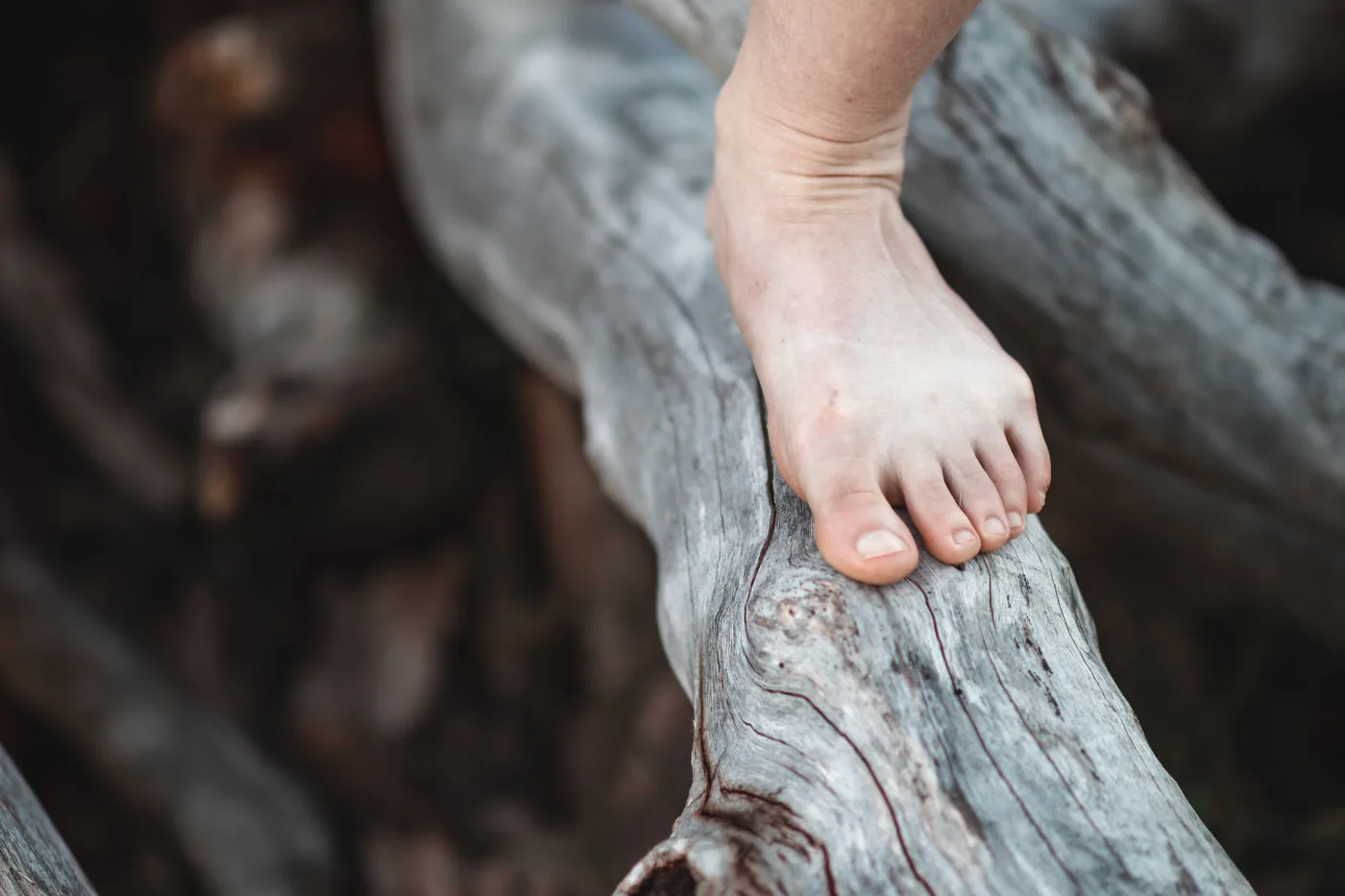
Free the feet. Soles are sense organs, dense with the receptors the whole system leans on, and cushioned shoes are mittens for them. Barefoot time at home, on wood, tile, and carpet, lets the feet feel the ground again. Better still is honest terrain: grass, a garden path, and, on Long Island, the shoulder-season beach, where soft sand asks the ankles questions no sidewalk ever will.
Consider the slow arts. Tai chi keeps appearing in research on falls for a reason: it is balance training disguised as tranquility, continuous weight-shifting done slowly enough to be studied by your own nervous system. Local classes tend to welcome beginners of every age.
Two honest cautions. Train near something you can hold, always, because wobbling is the point and falling is not. And if what you feel is not wobble but dizziness, spinning, or lightheadedness, that is a different matter entirely and belongs with a clinician, not a towel on the bathroom floor. Nothing here is medical advice; it is maintenance, for a system that has been maintaining you.
The Ground Underneath
There is one more thing the single leg teaches, and it may be the reason the posture shows up in practices far older than any study. You cannot stand on one leg while living in tomorrow. The moment your mind leaves for the meeting or the worry, the ankle tells on you. Balance is enforced presence, attention with a consequence, the body requiring you to be exactly where you are for as long as you care to stay upright. Two minutes at the sink, twice a day, morning and night: it will steady more than your stance.
Loading comments…