
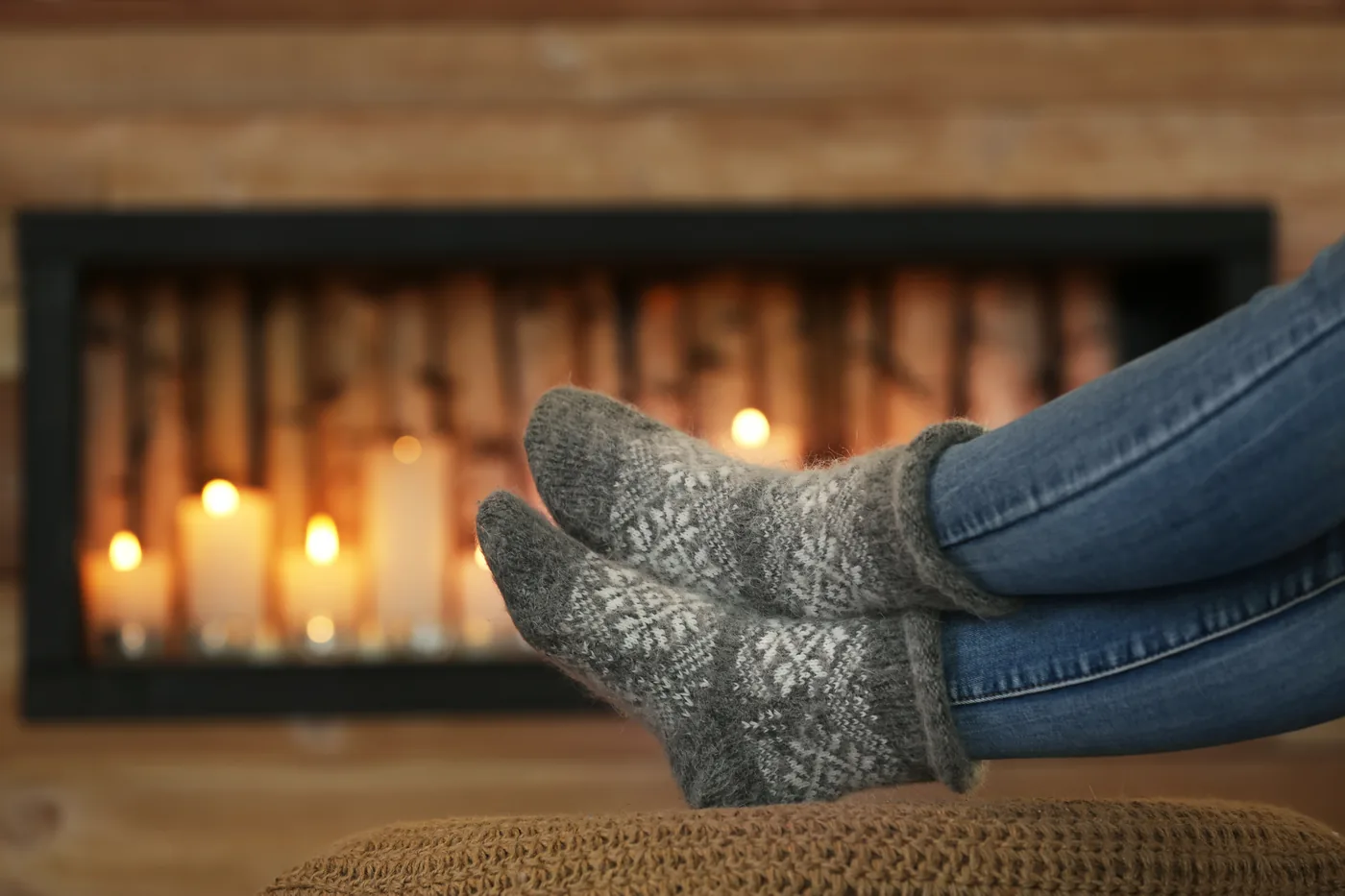
You know where every sweater in the house is. There is one on your desk chair, one in the car, one folded by the couch for the exact moment the evening turns. You have sat in restaurants with your hands pressed between your knees, slept in socks beside someone radiating heat like a woodstove, and been told, your whole adult life, that it is seventy-two degrees in here and you cannot possibly be cold. You are cold. And it is not a quirk, a weakness, or your imagination. It is physiology, and it has a logic worth knowing.
Cold hands, warm core
Start with the strangest fact in the whole subject: on average, women's core temperature runs the same as men's or very slightly warmer, while their hands and feet run measurably colder, often by several degrees. The cold you feel at your fingertips is real, and so is the warmth at your center. Both readings are true at once.
That is because the body does not try to keep all of you warm. It tries to keep the middle of you warm: the heart, the liver, the brain, the organs that cannot tolerate a temperature drop. Everything else is negotiable. When the air cools, the body narrows the small blood vessels in the skin, hands and feet, pulling warm blood inward to defend the core. Your extremities are not failing to stay warm. They are being spent, deliberately, to protect what matters more.
Women's bodies tend to make that trade earlier and more firmly. Part of it is architecture. A smaller body has more surface area for its volume, so it loses heat to the air faster, the way a teacup cools before a kettle does. Part of it is insulation. Women carry more of their body fat just under the skin, distributed in a layer that does a fine job of holding heat in the core and an equally fine job of keeping it away from the skin, which is where all of your cold sensors live. The body stays warm. The surface, where the feeling happens, stays cool.
And part of it is the furnace itself. At rest, a large share of the body's heat comes from muscle, which burns fuel constantly even when it is doing nothing. Men average considerably more muscle mass, which means more resting heat production, which means the room can drop further before their bodies notice. Less muscle is not a flaw, but it is a smaller furnace, and a smaller furnace heats a house more slowly.
The room was never set for you
Here is the part that reframes decades of thermostat arguments. The comfort standard that governs how office buildings are heated and cooled is built on a model developed in the 1960s, and the metabolic rate at the center of that model was based on an average man. Researchers who went back and measured actual metabolic rates in women doing light office work found the standard can overestimate their heat production by as much as a third.
Sit with that. The building is not neutral. The conference room that feels brisk to one person and arctic to another is running a formula with someone else's body in it. For years the freezing half of the office has been treated as the anomaly, when the honest description is that the math was never done for them.
This does not win you control of the thermostat. But it should retire the idea that feeling cold at work is a personal failing, a fussiness, something to apologize for. You are not bad at being in rooms. The rooms were calibrated to a body you do not have.
The moving set point
There is one more layer, and it is hormonal. Estrogen influences the blood vessels near the skin, encouraging exactly the heat-conserving narrowing described above, which is part of why cold hands and feet are so much more common in women to begin with. And the set point itself moves. Across the menstrual cycle, core temperature rises by roughly half a degree Fahrenheit after ovulation and stays elevated until the next cycle begins. In the years around menopause, the system that holds temperature steady becomes more reactive, which is why the same body can be freezing at four o'clock and flushed with heat at four in the morning.
None of this is malfunction. It is a thermostat that was given more than one job. But it means the feeling of cold is not a fixed trait you can be talked out of. It is a reading that genuinely changes week to week, and treating it as information rather than complaint is the beginning of handling it well.
What actually warms you
Most people fight cold the least effective way: they raise the air temperature and wait. There are better levers.
Warm the hands and feet first. Because the cold you feel is concentrated in the extremities, warming them changes your whole-body sense of comfort out of proportion to the effort. Real slippers with insulation, not just socks on a hard floor. Fingerless gloves at a cold desk, which look eccentric for exactly one day. A mug held in both hands, which is delivering heat to the densest patch of cold sensors you own. If your feet are warm, you will forgive a room a great deal.
Use your muscles, because they are the furnace. Two minutes of stairs, a brisk loop around the block, twenty slow squats while the kettle heats: movement raises heat production immediately and the warmth outlasts the effort. A cold afternoon often calls for a walk, not another layer.
Layer the core, but do not stop there. A warm trunk convinces the body it can afford to send blood back out to the hands and feet. A vest over warm feet beats a heavy coat over cold ones.
And eat. Digestion produces heat, and a body running on coffee and resolve has nothing to burn. The mid-afternoon chill that arrives like weather is sometimes just a missed lunch announcing itself.
When cold is a message
Running cold is usually just a body doing its arithmetic. But sometimes it is a signal. If cold intolerance is new, or arrives with relentless fatigue, thinning hair, or heavy periods, it is worth a conversation with your clinician, because an underactive thyroid and low iron both turn the furnace down and both are common in women. If your fingers go white or blue in the cold and ache as they warm, that pattern has a name, Raynaud's, it is far more common in women, and it is worth mentioning rather than enduring. None of this is cause for alarm, and none of this page is a substitute for medical advice. It is simply the difference between a cold body and a cold body trying to tell you something.
The warm conclusion
There is a long tradition of treating women's cold as a punchline: the stolen sweatshirts, the icy feet under the blanket, the cardigan in August. Fine. Keep the jokes. But drop the apology that tends to come with them.
You are not too sensitive. You are living in a body that defends its center fiercely, loses heat faster than the standard model, and does its feeling at the surface, in rooms that were tuned to someone else. Being cold in that arrangement is not a failure of toughness. It is an accurate report.
So this week, believe the report. Warm your feet before you blame yourself. Take the walk instead of suffering nobly at your desk. And the next time someone tells you it cannot possibly be cold in here, you can smile, hold your tea with both hands, and know that the math is on your side.



Loading comments…