
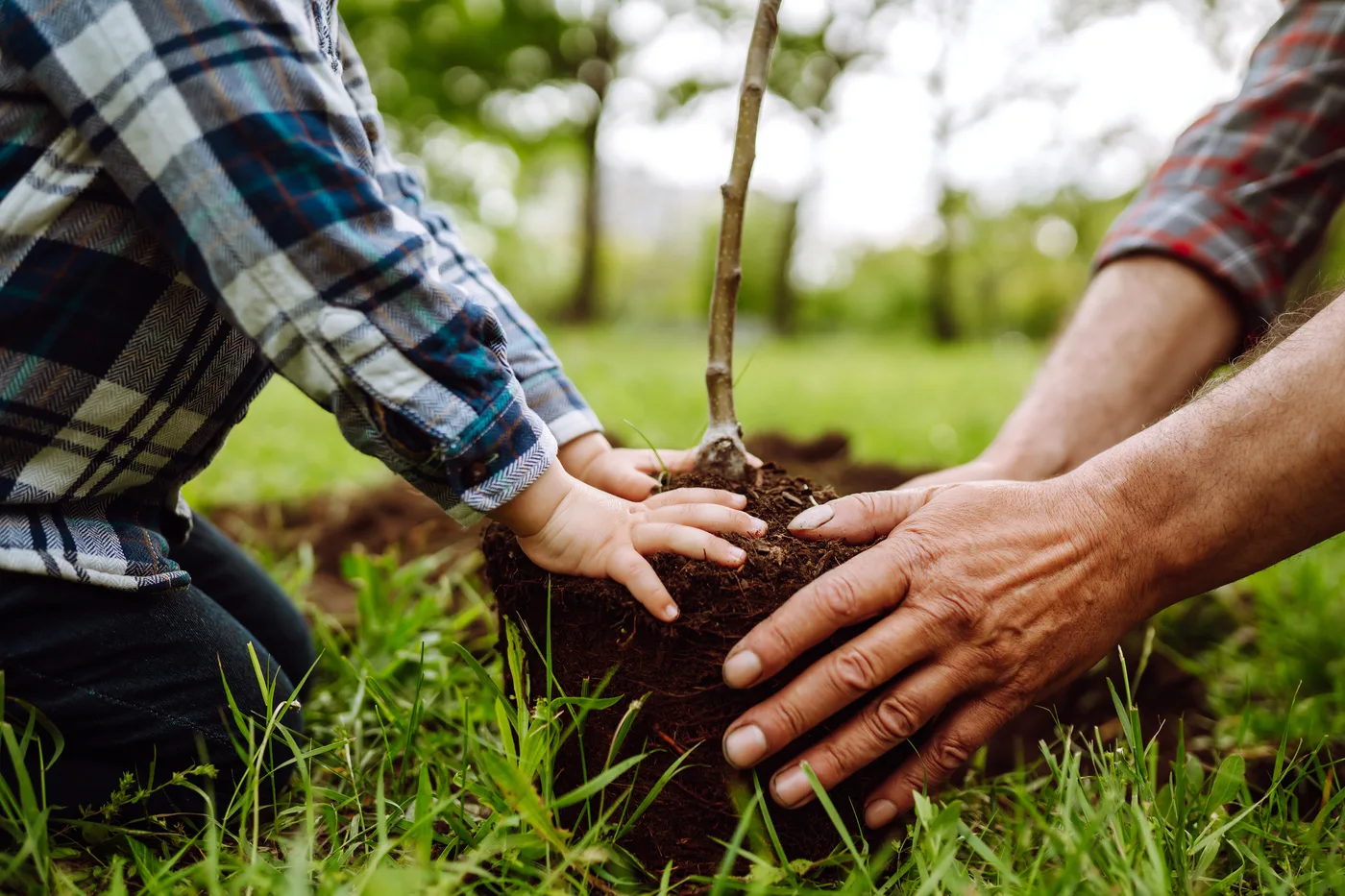
The shade you sat in this summer was somebody's decision. The maple over the picnic table, the oaks along the parkway, the beach grass holding the dune together under your feet: each one was put there by a person who understood, at the moment of planting, that the full grown version was not for them. They knelt in the dirt anyway, patted the soil around something the size of a pencil, and walked away from a gift addressed to a stranger. It is worth asking when you last did anything like that.
An inheritance you never signed for
Once you start looking, the category is everywhere. The library you use was endowed by people long past using it. The trail you hike was cut and blazed by volunteers whose names are on no sign. The tomatoes in your garden descend from seeds somebody saved, season after season, for no reason except that the line should continue. Most of what makes an ordinary day pleasant is the unfinished business of people who accepted that the payoff would land after they left.
We do not think about this much, and the reason we do not is instructive. The modern week is built around the closed loop: effort in, result out, ideally by Friday. We track, we measure, we optimize, and everything in the culture agrees that an act which cannot show its return is an act that needs to justify itself. Planting for a stranger fails every one of those tests. That is precisely what it is for.
The muscle that atrophies
Acting without a feedback loop is a capacity, and like any capacity it fades when unused. If every generous act you perform comes with a thank you note, a like, a receipt for taxes, or at minimum the warm sight of the recipient's face, then your generosity has quietly become a transaction with very soft terms. There is nothing wrong with those acts. But they exercise a different muscle than the act nobody will ever trace to you.
The untraceable act does something specific to the person performing it. It loosens the grip of urgency. It breaks, for an afternoon, the spell that says your effort only counts if you are present for the counting. People who make a habit of it describe a particular steadiness that follows, a sense of being stitched into a longer piece of fabric. You stop being only a consumer of the previous generations' shade and become, in a small way, weather for the ones coming.
The season is on your side
If the idea appeals to you, the calendar is cooperating. Fall is the planting season that most people miss. In the Northeast, trees and shrubs set into cooling soil spend their energy on roots instead of leaves, which is why a tree planted in autumn often establishes better than the same tree planted into the rush of spring. Spring bulbs, daffodils and crocuses and the rest, go into the ground in the fall too, a small buried promise that will keep itself without any further help from you.
On Long Island the tradition has a particular local face. Beach grass goes into the dunes by hand, plug by plug, often planted by volunteers on cold mornings, and those plantings are much of what stands between the shoreline neighborhoods and the winter storms. A native oak set into a yard becomes, over decades, a whole economy: acorns, nesting birds, and the caterpillars that native oaks support in greater numbers than nearly any other tree you could choose, which in turn feed the chickadees you will enjoy long before the shade arrives.
Not everything you plant goes in the ground
The dirt version is the clearest version, but it is only one door into the practice. The real definition is wider: one act, each season, whose benefit you will not collect.
Write down the recipe. The one that lives in your hands and nowhere else, the sauce or the bread or the holiday dish that dies with you unless it is committed to paper. Write it with the little corrections nobody ever says out loud, and put it where it will be found.
Write down the story. Every family has two or three, and every family assumes somebody else is keeping them. An hour with a notebook, or a voice memo recorded on a walk, is an heirloom manufactured out of nothing.
Fix the thing on the trail. Teach the skill without keeping tabs on the student. Give to the small local fund that plants street trees or buys instruments for the school, the kind of gift too small for a plaque, which is rather the point. Plant the fig cutting for whoever owns the house after you.
The objection worth answering
There is a voice that finds all this futile, and it deserves a fair hearing. Why plant what you will not sit under? The stranger will never thank you. The oak may outlive your name entirely. In a century nobody will know which hands did the kneeling.
But notice what the objection assumes: that the value of an act lives in the credit for it. Stand under any great tree and the assumption falls apart on its own. The planter is gone, the credit is gone, and the shade is fully, presently, generously here. The value did not leak out when the name wore off. If anything the anonymity has refined it, the way a gift becomes purer when it can no longer be repaid.
And the planter was not cheated, either. They got the one part that was ever available to them: the afternoon itself, the smell of opened soil, the pleasant soreness, and the private knowledge, carried for the rest of their life, that something of theirs was out there growing. That knowledge turns out to be a remarkably durable form of wealth. No market moves it. Nothing recalls it.
This week, while the ground is warm
So here is the invitation, sized to fit an ordinary life. Before the season turns, do one thing whose payoff is addressed to someone you will never meet. Put a spade in the ground if you can: a native oak or serviceberry, a bag of daffodil bulbs along the fence line, three plugs of grass in a dune restoration if the shore is your place. If the ground is not available to you, choose the recipe, the story, the repair, the unmarked gift.
Do it without photographing it. Tell no one, or tell one person, but let the act stay mostly unwitnessed, because the silence around it is part of the instrument. Then notice, in the days after, the small shift in how the world looks: every mature tree slightly changed, every shaded street revealed as a message that someone left for you, back before you existed to receive it. You have been on the receiving end of strangers your whole life. It is a fine thing, once a season, to turn around and face the other way.

Loading comments…