
Somewhere around four in the afternoon your eyes file a complaint. It arrives as grit, or a dull ache above the cheekbones, or the odd discovery that the room has gone slightly soft at the edges when you finally glance up from the screen. You blink, rub, carry on. But notice what your eyes have actually been asked to do since morning: the laptop at two feet, the phone at ten inches, the coworker across a table, the phone again. An entire waking day, and your gaze may never once have landed on anything farther away than the far wall. The eye is an instrument with an enormous range, and most of us now play a single low note on it from breakfast to bed.
The Muscle That Never Clocks Out
Focusing up close is work. Ringing the lens of each eye is a small circular muscle, the ciliary muscle, and when you read these words it is contracted, letting the lens thicken and bend light from a near object onto the retina. Optometry calls this accommodation, which is a gentle word for what is, mechanically, a sustained clench. Look across the street and the muscle releases; the lens flattens; the eye settles into what is close to its resting state. Distance, for the human eye, is not another task. It is the posture the instrument relaxes into when nothing is being demanded of it.
Now run the arithmetic of an ordinary day. Ten or twelve hours of near work is ten or twelve hours of that small muscle held in contraction, with breaks measured in seconds. No other muscle in the body is treated this way. You would not hold a shopping bag at arm's length from breakfast to bed and be surprised at the ache. The tired, heavy, faintly bruised feeling behind the eyes at day's end is not mysterious and it is not imaginary. It is a muscle asking for the thing you have not given it since morning: something far away to look at.
There is a second, humbler mechanism working alongside it. People blink far less when they concentrate on a screen, often less than half as often, and each unblinked minute leaves the surface of the eye a little drier. The grit is real grit, or near enough: a tear film asked to last three times longer than it was made to. Screens did not invent close work, but they concentrated it, and they added this quiet tax on top.
A Body Built for the Horizon
It helps to remember what the equipment is for. For nearly all of human time, a person's day was spent outdoors at a hundred focal distances: the path just ahead, the tree line, the weather coming in from far off. Near work existed, but it came in stints, stitching or sorting or whittling, bracketed by a world that constantly pulled the gaze outward. The modern arrangement inverts this completely. We now do our living at arm's length and visit the distance on weekends, and the eye, which adapted to the first world, spends its whole career in the second.
The inversion seems to matter most when eyes are still growing. Researchers studying childhood nearsightedness have observed, repeatedly and across countries, that children who spend more of their day outdoors are less likely to become myopic, an association strong enough that some school systems have redesigned recess around it. The reasons are still being worked out; the brightness of daylight, which is many times anything indoors, appears to matter, and so may the simple fact that outdoors there is very little to look at up close. None of this is a prescription, and adult eyes are a different case from growing ones. But it points at the same moral from another direction: distance is not a luxury for the visual system. It is part of the diet.
The Far Look as Practice
The repair is almost embarrassingly available. It costs nothing, requires no equipment, and can be done in a bathrobe. You look at something far away, and you keep doing it, at intervals, all day.
Take the twenty-second glance. Eye doctors have long passed around a convention called 20-20-20: every twenty minutes, look at something at least twenty feet away for at least twenty seconds. The numbers are a mnemonic, not a dosage, and the evidence for the exact formula is thinner than its fame. But the truth it encodes is solid mechanics: the clench needs regular release, and a glance out the window will not do it. Twenty seconds is roughly how long the system takes to actually let go. Look at the farthest thing you can see and stay there until it comes into easy focus.
Aim your desk at the longest view in the room. If you can face a window, face it; every pause then defaults to distance instead of to the wall. If the window shows another wall, face the longest interior sightline instead, down the hall rather than into the corner. You are arranging for your idle gaze to fall on the far note instead of the near one.
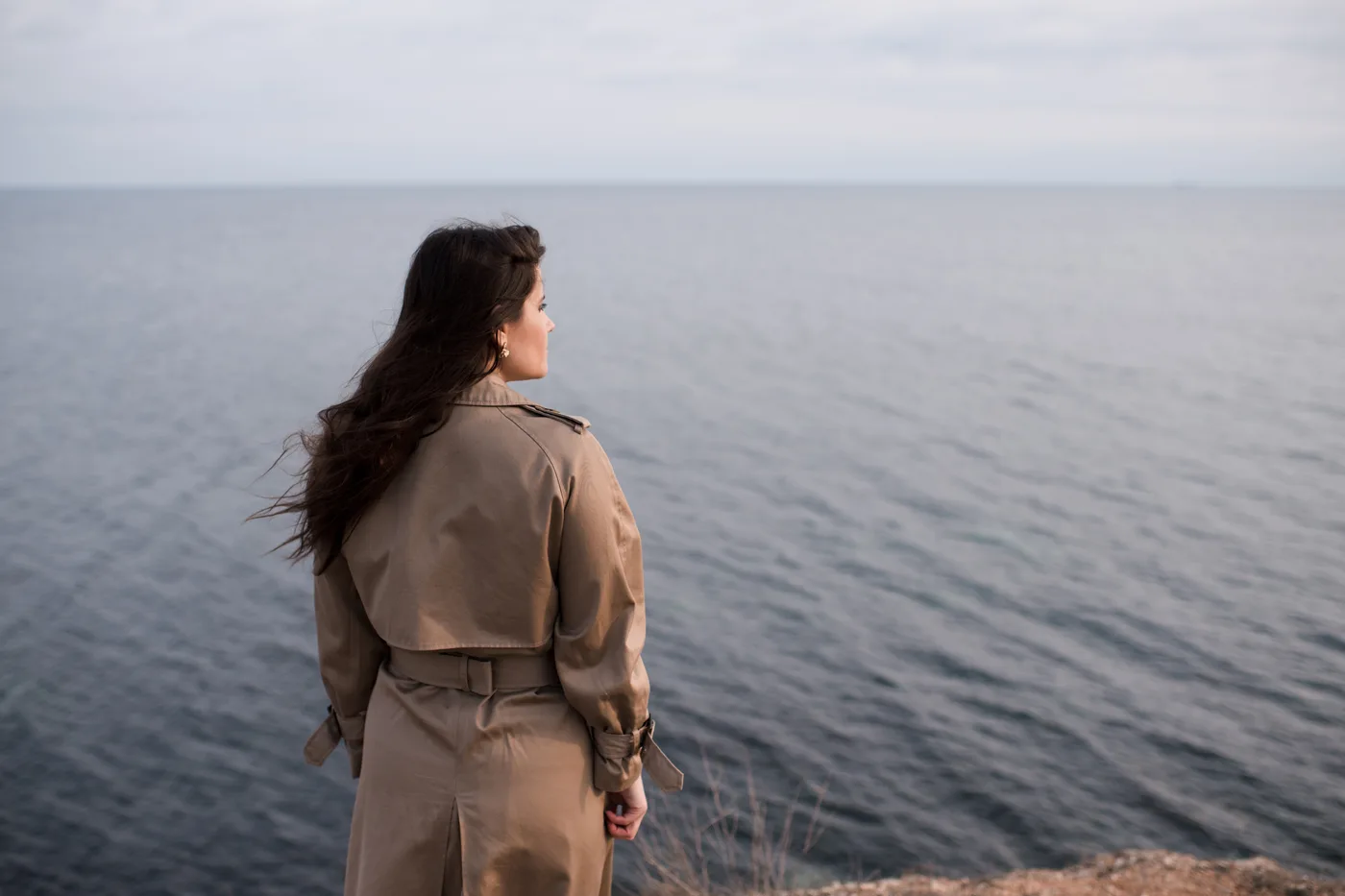
Give the phone a focal rival. The phone's distance is the nearest and most habitual of all. Twice a day, let a real vista outrank it: eat lunch where you can see sky, take the after-dinner stretch of sidewalk with your head up, stand at the back door with the coffee and look at the trees, not the feed. On Long Island the horizon is rarely more than a short drive away, and a beach in September, emptied of July, is the best optometry appointment that requires no referral: miles of uninterrupted distance in every direction, and nothing at ten inches asking for you.
Blink on purpose at the screen. A few slow, complete blinks once an hour, the kind that actually touch, resurface the eye. It sounds too small to matter. So does the unblinked hour that made it necessary.
And a plain word about symptoms: the ordinary end-of-day ache eases with rest and distance. Blur that does not clear, persistent dryness, headaches that arrive with reading, or any sudden change belongs in front of an eye doctor, not a habit. This piece is about the visual equivalent of stretching, and stretching is not a substitute for a clinician.
Where the Eye Rests
There is one more thing the far look does, and it is not optical. Attention follows the eye. At ten inches the world is your inbox; at the horizon it is weather, water, the neighborhood going about its evening, none of it addressed to you. People have always sought out long views to think in front of, and anyone who has stood at the ocean's edge knows the odd loosening that comes with it, the way problems change size in front of enough distance. The old instinct to walk to the water when something needs deciding is, among other things, an instinct about focal length.
So notice, today, how far away the farthest thing you have looked at actually was. Then find a window, or a shoreline, or the end of the street, and give your eyes the one thing the day never offers them. The muscle lets go. The surface resurfaces. And for twenty seconds, nothing within arm's reach can have you.


Loading comments…