
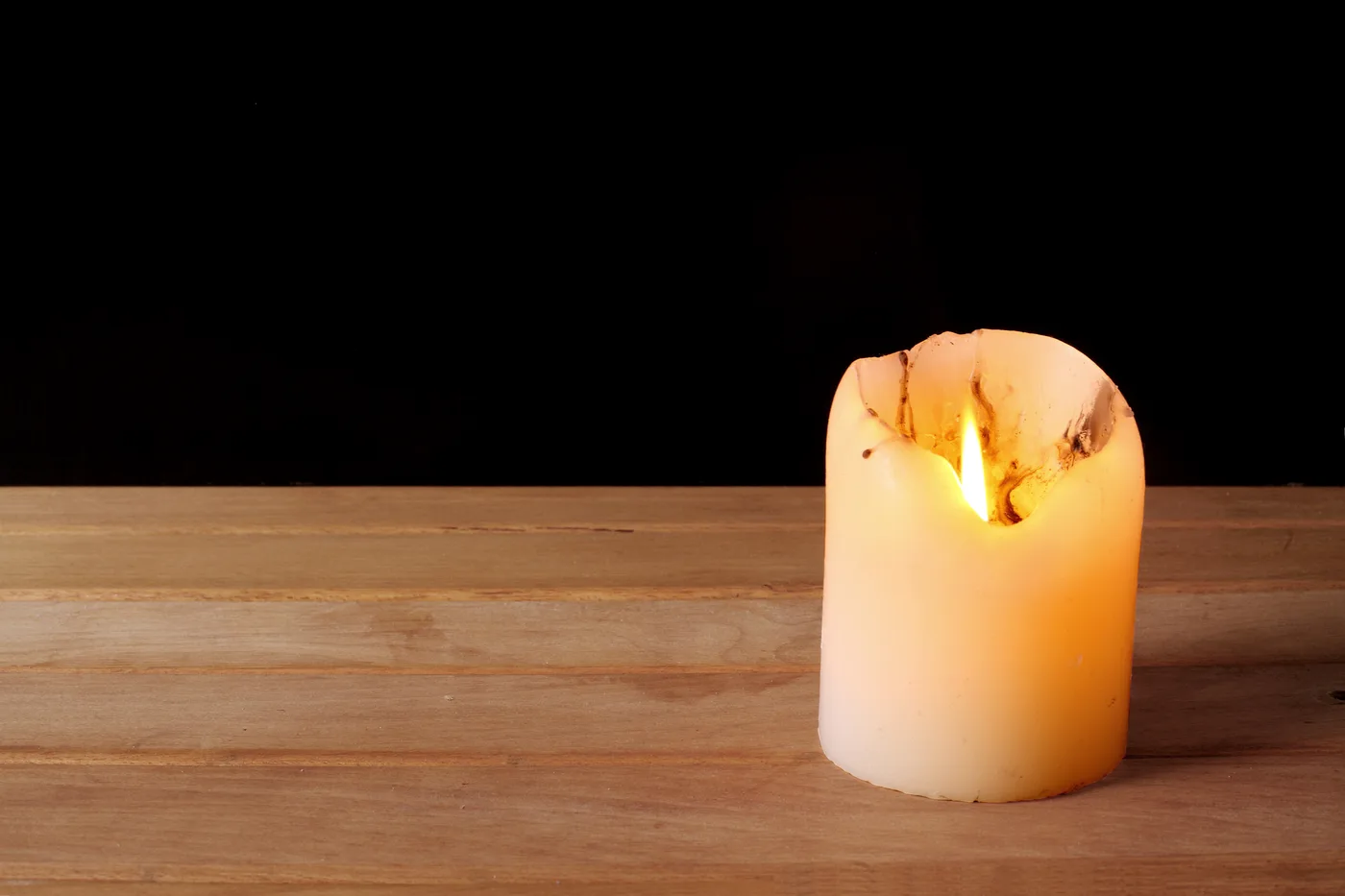
The match scrapes, catches, and for a moment the whole room rearranges itself around a point of light smaller than your thumbnail. You have done this before a birthday cake, at a power outage, at a table set for someone you wanted to impress. Every time, something in the room changes that has nothing to do with brightness, because a candle is a terrible source of light and always has been. Electricity beat it a century ago and yet the candle did not disappear. It moved. It left the ceiling fixture's job and kept the other one, the older one, the job it had all along: not to light the room but to mark it. A lit candle says, without a word, that this hour is not the hour before it.
Why a Flame Holds the Eye
Sit anything else on the table, a stone, a bowl, a phone face down, and the eye slides off it. A flame, the eye returns to. It moves constantly and never repeats itself, bright enough to draw the gaze and dim enough not to punish it, and it sits precisely at the edge between order and accident: a shape you recognize every time and can never predict. Attention loves exactly this. Perfect stillness gives it nothing to do and it wanders; a screen gives it too much and it scatters. A flame gives it one small, live, changing thing, and attention settles on it the way a bird settles on the one moving branch.
People have been staring into fire for as long as there have been people, long evenings of it, and some traditions turned the instinct into formal practice, a candle set at eye height and watched, softly, as a way of gathering a scattered mind onto a single point. You do not need the formal version to feel the ordinary one. Anyone who has lost ten minutes to a fireplace knows the state: alert and quiet at once, thinking loosened but not gone. The flame does not empty the mind. It gives the mind one thing, which for most of us is the closest thing to rest attention gets.
The Oldest Timer
Before clocks were common, a candle was one. Marked down the side in rings, it burned through the hours at a steady pace, and people told time by how much of it was gone. The technology is obsolete; the idea is not. A candle is still a duration made visible. It is lit, it burns, it ends, and everything that happens between the lighting and the snuffing belongs to one bounded stretch of time.
This is the part worth stealing. Most of what exhausts people about modern time is that nothing in it ends. The workday leaks into the evening, the meal dissolves into the scrolling, the visit trails off rather than closing. A candle, lit on purpose, is a frame put around an hour: while this burns, we are doing this. And the snuffing matters as much as the lighting. Pinching out a flame at the end of a meal or a task is a small, physical sentence that says that is finished, and the mind, which takes its cues from the body far more than we admit, files the hour as closed.
What the Traditions Agree On
Nearly every tradition that has survived long enough to have furniture puts a flame at its serious moments. Candles are lit to open a sabbath and to close a day, set alight for the dead and kept burning for the missing, carried in processions, placed in windows for travelers, lit in hospital chapels by people who could not tell you exactly what they believe but knew, walking past, that this was the thing to do. The traditions disagree about nearly everything else. About this they are unanimous, and it is worth asking what they all noticed.
What they noticed, plausibly, is that a candle is commitment made visible. Lighting one is a deliberate act with a cost: a thing consumed, a small fire accepted into the room, something that now must be tended and cannot be entirely ignored. It is intention taken out of the head and set on the table, where it stays lit whether or not your thoughts wander, which is exactly what thoughts do. The candle holds the vigil so you do not have to hold it perfectly. In a season of grief, people discover this by instinct: lighting a candle for someone is a way of remembering them that does not require summoning the right feeling on demand. The flame remembers on your behalf, for an hour, and you are free to just sit with it.
An Act, Not a Place
This magazine wrote earlier this month about the small set-apart place, the shelf or sill nearly every culture keeps. A candle can live there, but it does not need to, and the practice here is different. The altar is about where; the candle is about when. It needs no shelf, no arrangement, no beliefs in order, and no permanence. It is portable punctuation. You can light one at a rented kitchen table a thousand miles from home and the hour is marked all the same. If a set-apart place is a chapel, a lit candle is a bell: not somewhere you go, but a way of saying now.
Three Candles Worth Lighting
The dinner candle. Light it when the food reaches the table, snuff it when the meal is over, and let those two acts define the meal. Nothing else has to change, no phone rules, no announcements. Households that try this find the table becomes a place people stay a few minutes longer, because the flame quietly declares the meal an event with a beginning and an end rather than a refueling stop.
The work candle. One candle, one task, lit at the start and snuffed either when the task is done or when you honestly stop. It sounds like decoration and functions like a contract. The flame in the corner of your eye is a steady, wordless reminder of what this hour was declared for, and snuffing it early, in full view of yourself, is just uncomfortable enough to keep you at the table.
The remembering candle. For a person, an anniversary, a hard date on the calendar. Light it without any plan for what to feel. Sit with it or walk past it; both count. Snuff it before you leave the room, and let that be the visit.
The Hour, Marked
None of this requires believing anything, and none of it is improved by expensive wax. A bag of plain candles costs less than a sandwich and holds a year of marked hours. What the practice asks is only that the lighting be deliberate: struck for a reason you could name, even if the reason is just this dinner, this hour, this name. The room will not get much brighter. Rooms never did. But you already know what changes when the match catches, because you have felt it every time, and it was never really about the light.


Loading comments…