
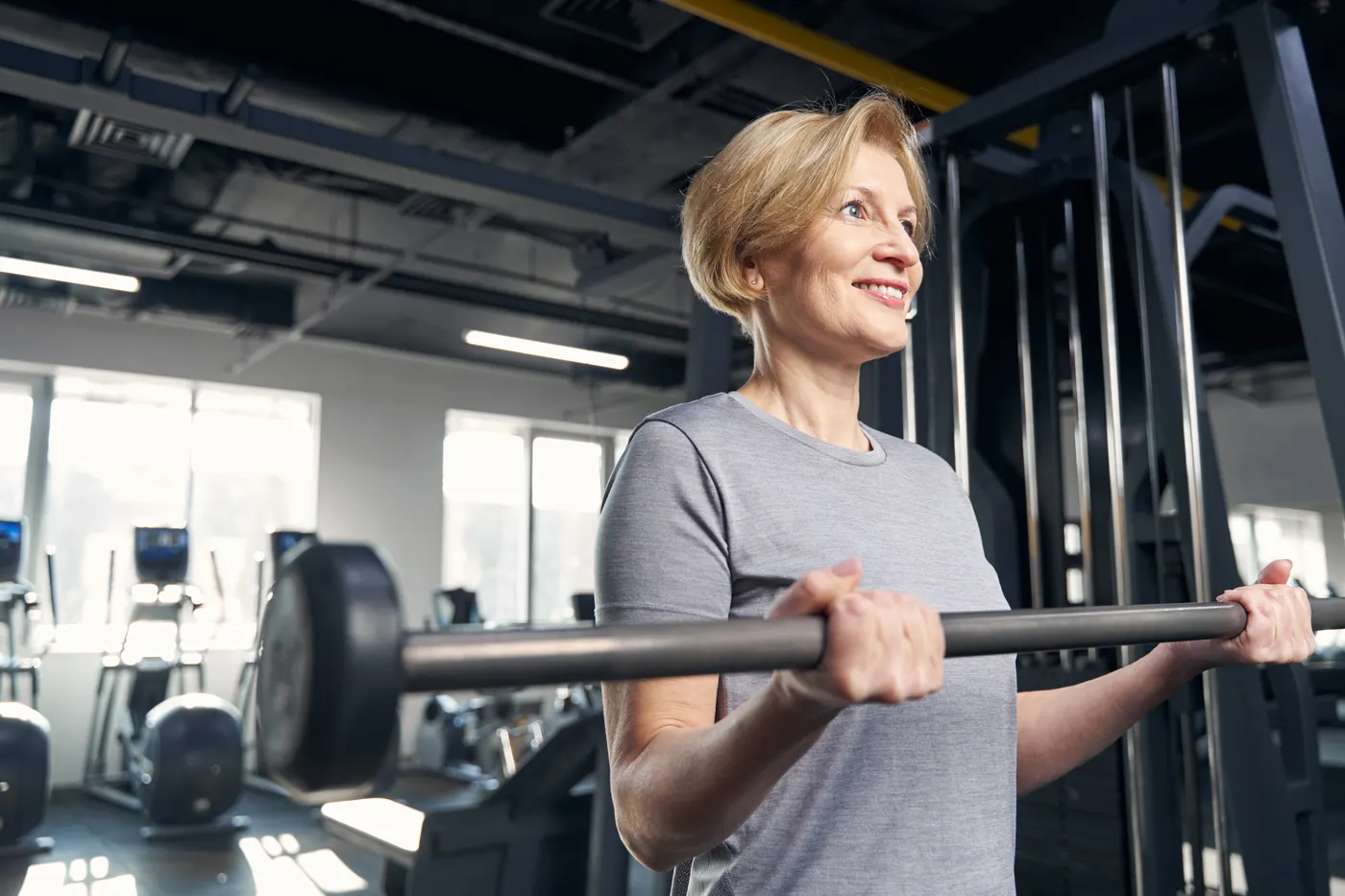
For a long stretch of years, women were steered toward cardio and away from anything heavy. The advice was well meant and it was wrong, and the correction has been one of the more useful shifts in women's health in a generation. The years around menopause bring changes to muscle and bone that are measurable and reasonably predictable, and resistance training is among the very few interventions with good evidence for pushing back against them.
What Changes, and When
Two things happen in parallel, and they are separate processes that happen to overlap in time.
The first is loss of muscle. From roughly the fourth decade onward, adults lose skeletal muscle steadily unless they do something to prevent it, and studies of women through the menopausal transition find meaningful declines in lean mass in the arms and legs across those years. Muscle is not only about strength. It is the body's largest site of glucose disposal and a major determinant of resting metabolism, so losing it quietly changes several things at once.
The second is loss of bone. The decline in estrogen around menopause accelerates bone turnover, and the years immediately surrounding the final menstrual period are when loss is fastest. The commonly cited figure is that women can lose up to a fifth of their bone density in that window. What makes this consequential is not the number itself but what it sets up decades later, when a fall that would once have been nothing becomes a fractured hip.
What Resistance Training Does About It
Muscle responds to load at every age that has been studied, including in the eighties and nineties. This is the most encouraging single fact in the field, and it means the window for starting has not closed for anyone reading this.
Bone responds too, though less dramatically and more slowly. Systematic reviews of resistance training in postmenopausal women generally find preserved or modestly improved bone mineral density at the hip and spine compared with controls who continue losing it. The mechanism is mechanical: bone remodels in response to the strain placed on it, and muscle pulling hard on its attachments is the signal. Walking and swimming are excellent for other reasons but do not deliver enough of that particular signal to move bone much.
The reviews converge on a few parameters. Loads that are genuinely challenging, generally described as around seventy to eighty-five percent of what you could lift once, matter more than volume. Two to three sessions a week is the range studied. Exercises that load the hip and spine through the long axis of the skeleton, squats, deadlifts, presses, step-ups, do more for bone than machine work that isolates a single joint.
The Benefits That Are Not About Numbers
Bone density is a proxy. What actually determines whether someone breaks a hip at seventy-five is whether they fall, and strength training addresses that end of the problem too, through balance, reaction time and the leg strength required to catch yourself. Trials of resistance and balance training in older adults consistently show reduced fall rates, which is arguably the more meaningful outcome.
Beyond that, women who take up lifting in midlife tend to report a set of changes that show up in no scan: better sleep, steadier mood, less back and knee trouble, and a shift in how they relate to their own bodies. Something happens when the measure of a workout becomes what you can do rather than what you weigh. Many women describe that reframing as the part that made it stick.
Starting Sensibly
Get taught. A handful of sessions with a qualified trainer to learn the basic patterns is the best money spent in this entire endeavor. Loaded movement done poorly is how people get hurt and then quit.
Two sessions a week is a real program. Full-body, forty-five minutes, a push, a pull, a squat or hinge, and something for the core. Three is better if it fits. Two done consistently for a year beats four done for six weeks.
Progress the load. The adaptation comes from the challenge increasing over time. If the same weight has felt comfortable for a month, it is no longer asking anything.
Expect it to feel heavy. The last two repetitions of a working set should be genuinely difficult. This is the piece most often missed, and it is the piece the bone research depends on.
Eat enough protein. Muscle cannot be built from a deficit of raw material, and protein needs are, if anything, higher in older adults than younger ones.
Before You Begin
This is general information rather than medical advice. Anyone with diagnosed osteoporosis, a prior fragility fracture, uncontrolled blood pressure or a cardiac condition should get individual clearance and, in the case of significant bone loss, specific guidance, since certain loaded spinal movements are approached differently when vertebral fracture risk is elevated. A conversation with your physician before starting is worth the appointment.
With that in place, the proposition is unusually good. Two hours a week, against changes that were once described as simply what happens to women in midlife and are now understood to be substantially modifiable. The body is still listening. It is mostly waiting to be asked.



Loading comments…