
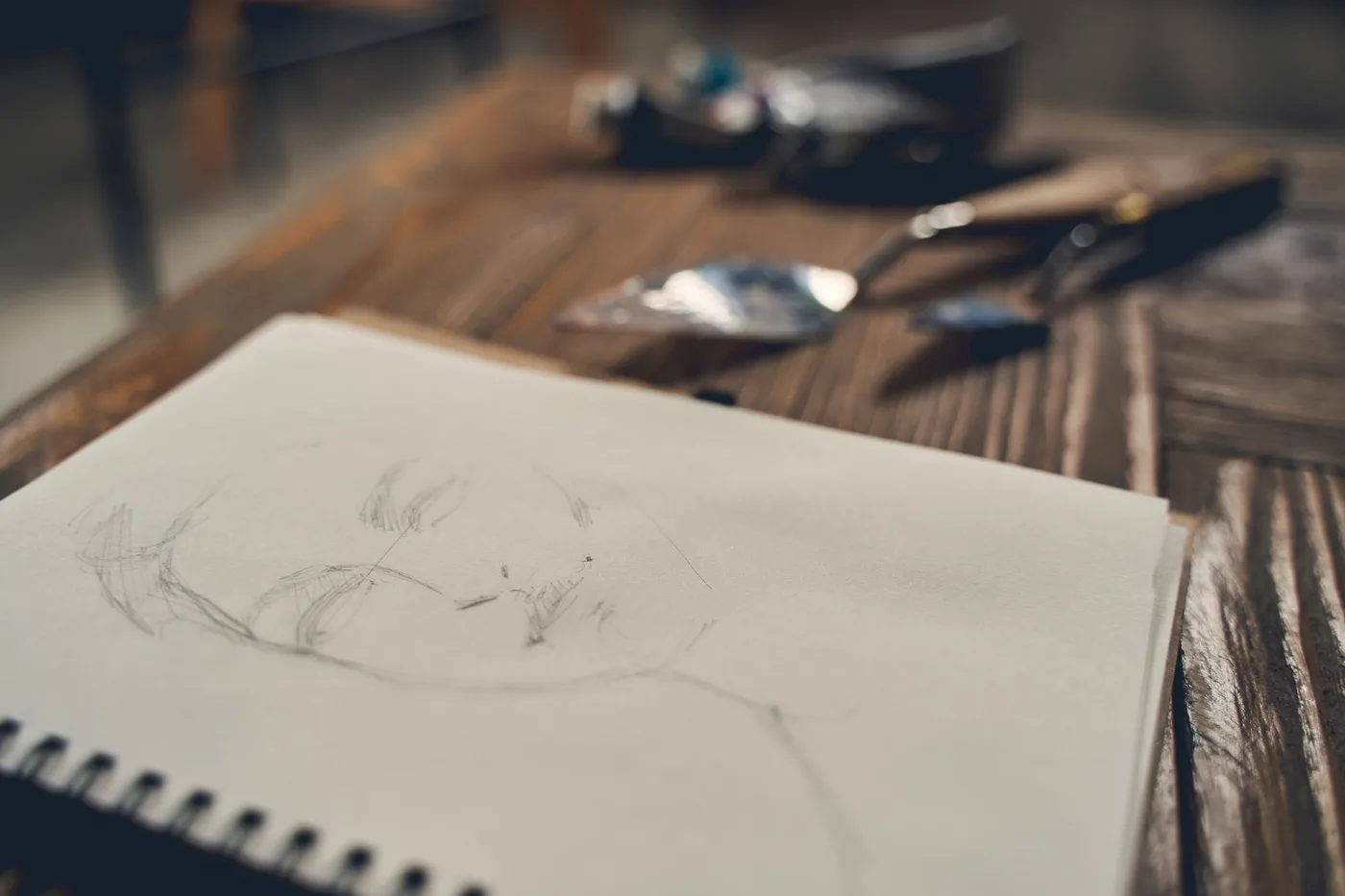
Put a pen on a sheet of paper, then look up at your other hand, resting on the table, and do not look down again. Let your eye travel slowly along the edge of your thumb, the crease at the knuckle, the line where the nail meets the skin, and let the pen follow at exactly the same pace. Five minutes later you will have a drawing that looks almost nothing like a hand. You will also have looked at a hand more closely than you have in years.
An old exercise with a plain name
This is blind contour drawing, and it has been a fixture of drawing classrooms for most of a century. The art teacher Kimon Nicolaides built his 1941 book, The Natural Way to Draw, around it, and Betty Edwards brought it to a much wider audience in Drawing on the Right Side of the Brain in 1979. Generations of students have spent their first week of class doing it, usually with some embarrassment, and many of them still talk about it years later as the moment drawing changed for them.
The rules are short. You look only at the subject, never at the paper. You move the pen as slowly as your eye moves along the edges. You keep the pen on the paper as much as you can. And you accept, in advance, that the result will be strange: lines that wander off the page, an eye that lands somewhere near an ear, fingers that overlap in ways fingers do not.
The strangeness is not a failure of the exercise. It is the exercise.
Why not looking helps you see
Most of us, when we try to draw something, do not actually draw what is in front of us. We draw what we know about it. We know an eye is an almond with a circle in the middle, so we draw the almond. We know a tree has a trunk and a round cloud on top, so we draw the cloud. These shorthand symbols are learned young, and they are very efficient. They are also why so many adults feel their drawing stopped improving somewhere around age ten.
Blind contour drawing takes the symbols away. When you cannot see the paper, you cannot check your line against your idea of a hand. All you have is the hand itself, and the actual path of its edge, which turns out to be far more irregular, surprising and specific than the symbol ever suggested. The thumb is not a sausage. It is a series of small turns, bulges and flat stretches, each one slightly different from what you would have guessed.
There is a second thing happening, and for many people it is the more valuable one. With the drawing out of sight, the inner critic has nothing to grade. It cannot tell you the proportions are off, because you are not looking at the proportions. The usual running commentary goes quiet, and what is left is a slow, absorbed kind of attention that feels closer to meditation than to art class. People who do this regularly often describe losing track of time in a way they rarely do when they are trying to make something good.
How to do it this week
You need a pen or a soft pencil, a few sheets of plain paper and a timer. A pen is better than a pencil if you can bear it, because you cannot erase, and the temptation to tidy up the result disappears.
Tape the paper down so it does not slide around when you are not watching it. Sit so that the paper is in front of you and the subject is a little to one side, where you can look at it comfortably without your eyes drifting back to the page. Some people turn their body away from the paper altogether.
Choose a subject with interesting edges. Your own non-drawing hand is the classic choice, because it is always available and endlessly complicated. A crumpled paper bag works beautifully. So does a bell pepper, a shoe with its laces undone, a houseplant, a set of keys or the face of someone who is willing to sit still and read.
Set the timer for five minutes and pick a starting point on the edge of the subject. Put your pen on the paper. Then begin moving your eye along the edge, as slowly as you can, and let the pen move at the same speed. Imagine that your eye is actually touching the object and your pen is recording the touch. When you come to an inner edge, a wrinkle or a fold, follow it in. When it ends, travel back out along it rather than lifting the pen.
Do not look down until the timer goes. This is the hard part. You will want to check. Your hand will feel lost. Keep going anyway.
When the five minutes are up, look at what you made. Try not to judge it as a picture. Look instead at the quality of the lines. Notice where they are slow and detailed and where they hurried. Notice the places where, despite everything, a line caught something true: the exact angle of a knuckle, the lip of a leaf.
A second version, once you are warmed up
After a few blind drawings, try what teachers call a modified contour. The rules are the same, except that you are allowed brief glances at the paper, only to place the pen when you start a new edge. Your eye still spends almost all its time on the subject. The drawing will hold together a little better, but it will keep the searching, alive quality of the blind version. Many working artists sketch this way for the rest of their lives.
What to expect
For the first few sessions, the drawings will look odd, and you may feel a little silly. That passes. By the end of a week of five-minute sessions, most people notice two changes. The first is on the page: their ordinary drawings, done while looking, start to carry more specific, observed lines and fewer symbols. The second is off the page: they start seeing edges everywhere. The curve of a coffee cup. The exact line of a neighbor's roof against the evening sky. The way a sleeve folds at the elbow.
That second change is the real gift of the exercise. It does not require any talent, and it does not depend on whether you ever make a drawing you would hang on a wall. It is simply a habit of looking longer and more honestly at ordinary things, and it carries into everything else you make, whether that is a garden bed, a paragraph or a meal.
Keep the pages
Date each drawing and keep them in a folder or a cheap sketchbook. Do not throw away the ugly ones, which will be most of them. Looking back after a month, you will not find a steady march toward realism. You will find a record of attention: a week when you looked hard at your own hand, a morning spent with a crumpled bag, an evening with the face of someone you love, drawn without once taking your eyes off them.
Tonight, before you turn on a screen, take five minutes, a pen and your other hand. Look only at the hand. Let the pen go where your eye goes. Then, and only then, look down.


Loading comments…