
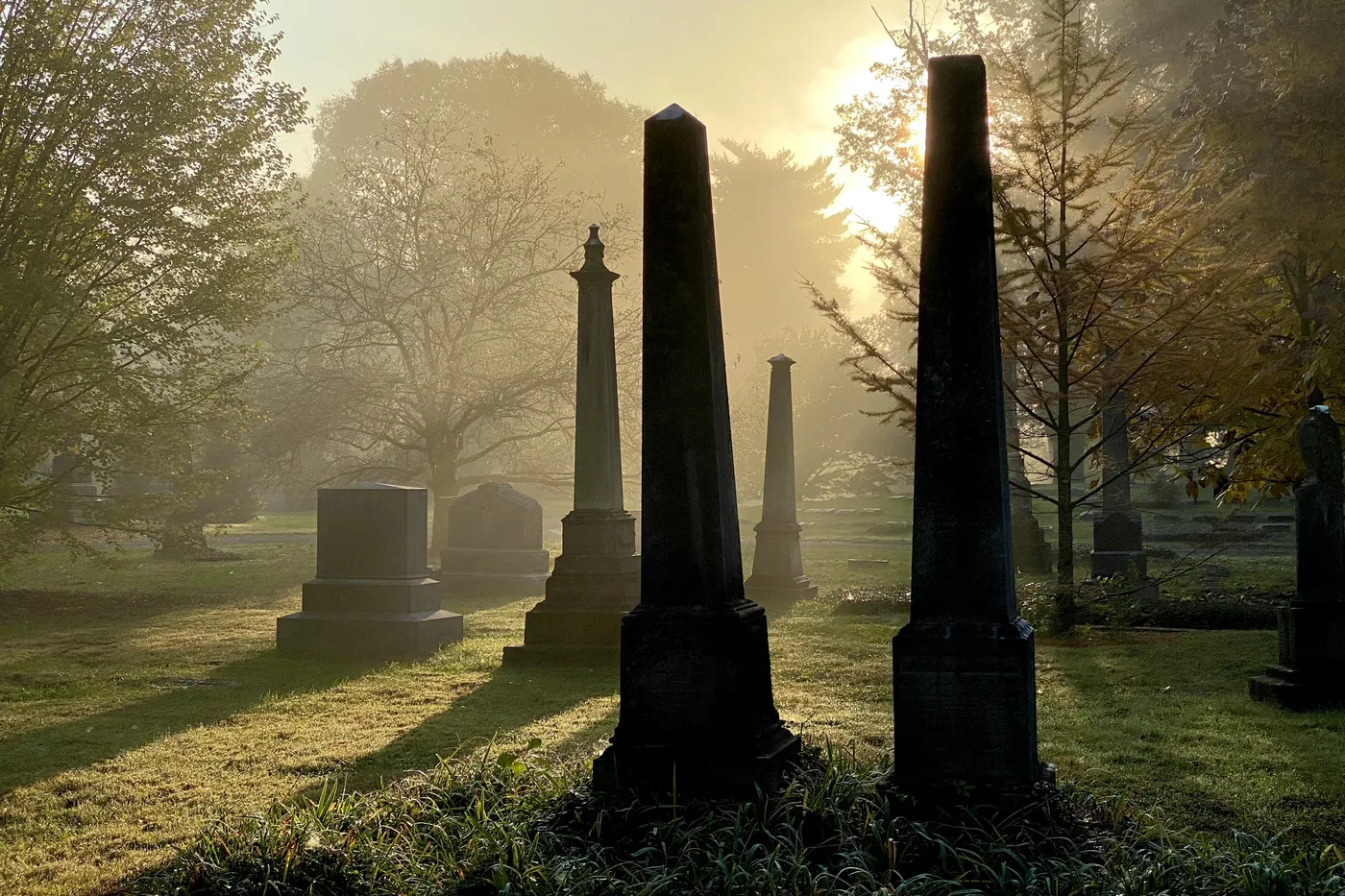
Somewhere near you there is a gate you have driven past a thousand times. Behind it the grass is cut, the trees are older than anything else on the street, and rows of stones lean very slightly in the direction the ground has settled. Most people only go through that gate on the worst day of a year. This is about going through it on an ordinary one, on purpose, with nowhere to be.
A place built for walking
It helps to know that cemeteries were not always places people avoided. In the early nineteenth century, crowded churchyards in American cities gave way to what became known as rural cemeteries: large, landscaped grounds on the edge of town, laid out with winding paths, ponds and specimen trees. Green-Wood in Brooklyn, founded in 1838, was one of them, and for decades it drew visitors by the hundreds of thousands. People came on Sunday afternoons to stroll, to sketch, to bring a lunch. Before the city had large public parks, the cemetery was the park.
That history tells you something the modern habit of avoidance hides. These places were designed to be walked through slowly. The paths curve so you cannot see far ahead. The plantings change with the season. The whole ground is arranged to make you stop.
Long Island has every kind. There are town burying grounds on the East End begun within a generation of the first English settlements, small family plots fenced at the back of old farm fields, churchyards in the middle of villages, and the large lawn cemeteries of the twentieth century spread across the middle of the island. Any of them will do. The older and quieter, the easier it is to begin.
What the stones actually say
The first thing you notice, if you read slowly, is the arithmetic. Every stone carries two dates, and the mind cannot help subtracting one from the other. Seventy-eight. Forty-one. Three. A row of small stones beside a larger one, all the same family name, all from the same few years. You do the sum without meaning to, and the sum is a life.
The second thing is how much people chose to say, and how little room they had to say it in. A name, a relationship (wife of, son of, beloved), sometimes a line of scripture or a few words of verse, sometimes a trade. Somebody stood at a stonecutter's counter and decided which twelve words would stand for this person for the next two centuries. Reading them, you feel the weight of that choice, and you start to wonder, privately, what your own twelve words would be.
The third thing is the stone itself. Older markers were often slate or sandstone, carved by hand, with winged faces or willows across the top. Later ones are marble, softened by rain until the letters are nearly gone. Victorian families liked obelisks, pointing upward, and you can date a section of a cemetery roughly by how many there are. The lichen on the north side of an old stone, gray-green and crusted, grows slowly, in some species only a millimeter or two a year. It has been at that work longer than anyone now alive has been walking around.
Why it steadies people
Many of the world's contemplative traditions include some practice of remembering that life ends. Monks in several traditions have kept a skull on the desk or meditated in charnel grounds. The Stoics wrote about rehearsing loss so that it would not find them unprepared. The point in every case was not gloom. It was proportion.
A walk among old graves does this gently, without anyone asking you to think any particular thought. The argument you had this morning, the email you are dreading, the thing you said at the party and keep replaying: none of it disappears, but it shrinks to its real size. Every person under these stones had a morning like yours. Most of what kept them up at night is now known to nobody at all. What remains, carved on the stone, is almost always about who they loved and who loved them.
People who make a habit of this tend to describe the same effect. They come out calmer than they went in, and slightly more tender toward whoever they see next. The dead make no demands. They simply make the living look more precious.
How to go
Go in daylight, alone or with one quiet companion. Morning and late afternoon are best, when the light comes in low and the stones throw long shadows. Check the posted hours; many cemeteries close their gates at dusk.
Walk the oldest section first. Most cemeteries grew outward from a starting point, often near the original church or the main gate. The oldest stones are usually there, and they reward slow reading.
Read three stones completely. Not a glance across a row: three stones, every word, including the small ones near the ground. Do the arithmetic. Notice the relationships. If the stone names a trade or a town, notice that too. Three is enough to change the pace of the visit.
Find one person and stay with them for a while. Pick a name that catches you, for whatever reason, and stand there for a few minutes. You do not need to pray, though you can. You might simply say the name once, quietly. In many traditions, speaking the name of the dead is a way of keeping them among the living, and there is something right about doing it for a stranger nobody has visited in a hundred years.
Sit down. Most cemeteries have a bench somewhere, often under the oldest tree. Sit for ten minutes without your phone. Listen to what is there: wind in the leaves, a mower somewhere, birds that have learned this is the quietest ground for a mile.
Be a good guest. Stay on the paths where you can, never lean on or rub old stones (rubbings and even gentle cleaning can damage soft marble and slate), and give real mourners a wide berth. If a funeral is in progress, leave that section to the family. You are visiting someone else's sacred ground, and a little formality is part of the practice.
Leave something small, or nothing. In Jewish tradition, visitors place a small stone on a grave as a sign that someone came. In other traditions it is a flower. If you feel moved to leave something, choose a thing that will not become litter. Most of the time, leaving nothing and taking nothing is the right way to visit.
What to carry out
You will not leave with a revelation, and you should not expect one. What you are likely to leave with is quieter: a sense of the long line of people who walked this same ground, worried about the same kinds of things, loved the same kinds of people, and were finally summed up in a name, two dates and a few chosen words.
On the way home, try one small question. If someone had twelve words to describe you, what would you want them to be? Not your title or your accomplishments. The words people actually carve. Then ask whether this week, as you are living it, is giving them anything to carve.
The gate is still there tomorrow. The stones are not going anywhere. That is, in the end, the whole lesson: they have time, and you have this afternoon.

Loading comments…