
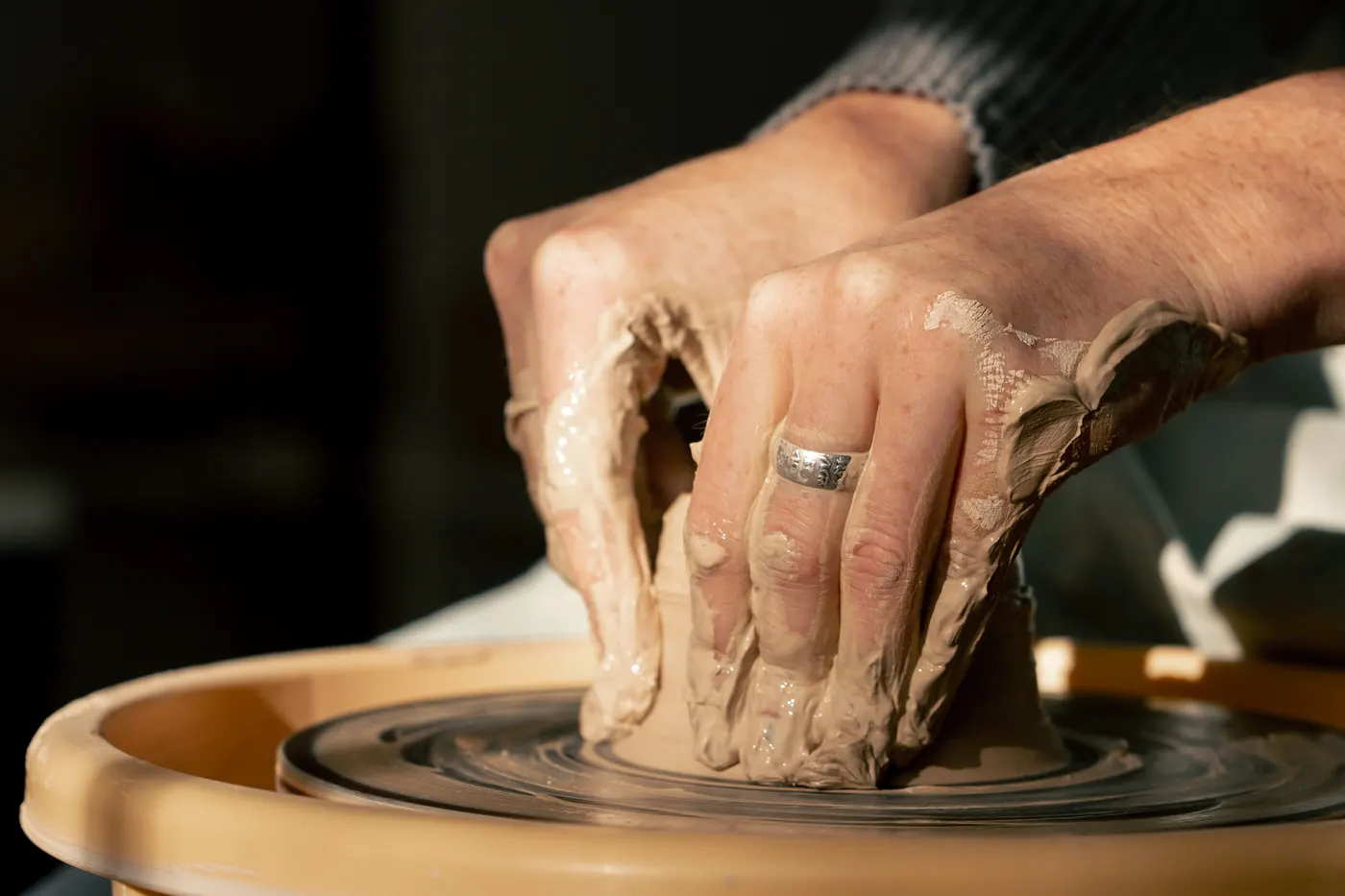
There is a particular quiet that arrives about twenty minutes into kneading bread, or sanding a board, or turning a lump of clay that will not center. You notice it afterward rather than during, which is the whole point. For a while there you were not managing anything or planning anything or rehearsing a conversation from Tuesday. You were just doing the next small thing that the material asked for. Most of us call this a hobby and treat it as the first thing to go when life gets full. It may be closer to the opposite.
A Very Old Arrangement
For almost all of human history, a person's hands and a person's survival were the same subject. You made the thing you ate off, mended the thing you wore, shaped the handle to your own grip. Skill lived in the fingers as much as in the head, and a life had a great deal of texture in it because everything you touched had been made by someone, often by you.
That arrangement ended recently and almost completely. Most of us now spend our working days moving symbols. The work is real and it matters, and at the end of it there is very often nothing you can hold. You cannot point to the day. You cannot run a hand along its edge.
This is not a lament for a simpler time, which was mostly harder and frequently worse. It is an observation about a mismatch. A body built over a very long time to make things is now largely used to sit and to type, and something in it goes quietly unfed. When people take up pottery or woodwork or knitting in their forties and describe the effect as a relief they cannot quite explain, that is what is being described.
Why the Mind Goes Quiet
Handwork settles the mind for reasons that are worth understanding, because knowing them tells you what kind of making to reach for.
The first is that it occupies exactly the part of attention that rumination uses. Worry is not a feeling so much as an activity, and it needs working memory to run. Shaping something requires continuous, low-level attention to a physical thing that keeps changing. There is not enough attention left over to also rehearse the argument, and so the argument stops, without you having to talk yourself out of it.
The second is that it is rhythmic. Kneading, sanding, whittling, the pull of yarn through fingers: these are repetitive, moderate, unhurried movements, and the nervous system reads that kind of movement as a signal that nothing is wrong. Breath lengthens on its own. Shoulders come down without being told. It is a very old form of self-regulation and it requires no belief in anything.
The third is that the task is completely honest. The clay is either centered or it is not. The joint either closes or it does not. There is no politics in it, no interpretation, no possibility of spin. For an hour you are dealing with something that cannot be persuaded, and there is enormous rest in that for a mind that spends its days managing things that can.
The Feedback a Screen Cannot Give
Making by hand returns something to you that most modern work has quietly removed, which is a proportionate relationship between effort and result.
You press too hard on the wheel and the wall thins and collapses, immediately, in front of you. You press correctly and it rises. The information arrives at once, it is unambiguous, and it is about what you actually did rather than about how it was received. Almost nothing else in adult life works this way. Most of what we do produces results that are delayed, partial, filtered through other people, or never visible at all.
There is also the matter of finishing. A great deal of contemporary work has no end, only a pause: the inbox refills, the project rolls into the next quarter, the thing is never done, only currently at rest. A loaf comes out of the oven. A bowl is glazed and fired and sits on the table. Something that did not exist this morning exists this evening, and you made it. That is a small event and it does more for a person than its size suggests.
And there is the matter of the senses. Warm dough, cold clay, the smell of cut pine, the particular sound sandpaper makes when the grain finally goes smooth. We spend most of the day in two senses, sight and hearing, both aimed at a lit rectangle. Handwork brings the other three back into the room, and a body with all its senses working is a body that is easier to be in.
Not Talent, and Not a Product
Two beliefs stop most people before they begin, and both need saying plainly.
The first is that you are not creative. This almost always traces back to a single moment in a classroom, decades ago, in which a drawing was compared unfavorably to another drawing. It is worth noticing how thin the evidence is for a conclusion you have carried this long. Making things is not a talent that some people were issued. It is a human capacity, in the way that walking is, and it responds to practice in exactly the ordinary way.
The second is subtler and more common in capable adults: the belief that it only counts if the result is good, or sold, or posted. That belief will take the medicine out of this faster than anything else. The moment the bowl exists to be admired, you are back in the world of performance and judgment, which is the world you were trying to put down for an hour.
Make things badly. Make things that are lopsided and unphotographed and given away or used until they wear out. The value is in the hour, not the object. The object is just the evidence that the hour happened.
Where to Start
Choose by the quality of the movement rather than by the appeal of the finished thing, and start smaller than feels serious.
Pick something rhythmic. Bread, knitting, sanding, weeding, whittling, hand-sewing. Repetitive, moderate, endlessly forgiving. These settle the system fastest and ask least of you on a tired evening.
Start with the kitchen, if nothing else appeals. It is the workshop almost everyone already owns. Bread from four ingredients, something chopped properly with a sharp knife, a sauce that needs stirring for twenty minutes and rewards you for staying. No new equipment and no explaining yourself.
Keep it in sight. The single biggest predictor of whether this continues is whether the materials are visible. A basket by the chair, a board left out. Anything that lives in a cupboard on a high shelf is a thing you will do twice.
Give it a small, fixed slot. Half an hour, two evenings a week, at a time that already exists. This is not a project that needs a free Saturday. Free Saturdays do not arrive.
Do it with your hands and not your phone. No tutorial playing, no podcast, at least at first. The quiet is the active ingredient and it will not survive a second stream of input.
Sit with the frustration. Everything handmade goes wrong repeatedly at the start, and the discomfort of being a beginner is part of what is being practiced. Learning to stay pleasant with yourself while your hands are clumsy is a skill that transfers to a great deal else.
Make something for someone. Occasionally, not always. A thing made by hand and given away carries something that a purchased thing cannot, and both people can feel it.
What Comes Back
People who take this up describe a set of returns that has very little to do with craft.
They sleep better on the evenings they make something. They notice a kind of patience arriving in other places, because a material that will not be hurried teaches you, over months, not to hurry. They find their attention span thickening slightly, which comes as a surprise, and which makes sense: attention is trained by being held on one thing, and almost nothing else in the day asks that of it.
And they describe a change in how they see everything else. Once you have made a badly fitting drawer, every well-made drawer in the world becomes visible to you. The made world stops being background and becomes a record of decisions and skill and other people's hands.
Underneath all of it is something simpler. Making a thing is a small argument, repeated weekly, that you are a person who can act on the world and leave a mark on it. Most of us go long stretches without much evidence of that.
Your hands remember more than you think. Give them something to do this week, and let the rest of you go quiet for a while.



Loading comments…