
Think about the last time you made plans with another man you are not related to. There is a decent chance the invitation had a drink built into it before anything else was decided. Grab a beer sometime. Come watch the game, I'll pick up a six-pack. The bar after work, the cooler at the tailgate, the round that says the workday is over. Nobody chose this exactly, and nobody owes an apology for it. But it is worth looking at squarely: for a lot of men, alcohol is not something that happens at social life. It is the thing social life is built on. And a structure you never look at is a structure you cannot change.
The grammar of the invitation
"Grab a beer" rarely means beer, exactly. It means: I would like to spend time with you, and here is a container for that, so neither of us has to explain ourselves. The drink gives the meeting a shape. There is a place to go, a thing to hold, a natural beginning and a natural end. No one has to say I miss you, or something has been on my mind and I want your read on it. The beer says it sideways, and sideways is the register a lot of men were raised to trust.
As shorthand, it works. It gets men into rooms together, and given how thin male social life can run in midlife, anything that gets men into rooms together deserves some respect. But notice what happens when the drink is taken out of the sentence. A walk? Dinner, no bar? Coffee on a Saturday? For many men those invitations feel strangely exposed, almost formal, as if removing the alcohol would make the point of the meeting too plain: that the point of the meeting is each other.
That reflex is the subject here. Not the beer itself, which is just a beverage, but the job the beer has been quietly doing, and the question of whether a man knows how to do that job himself.
What the drink is actually doing
Watch a bar table of men closely and you can see the drink working three jobs at once.
The first is mechanical. A glass is something to do with your hands and a metronome for the conversation. Lift, sip, set it down. Every pause has cover. Silence at a table of men can feel like a test; silence while everyone happens to be drinking is just drinking. The glass absorbs the gaps that would otherwise have to be carried by the people.
The second is chemical, and it is no mystery. Alcohol is a depressant. It turns down the vigilance that polices what many men let themselves say, the internal editor that screens for anything too warm, too worried, or too much. Two drinks in, a man tells his friend he has been scared about his health, or that he is proud of him, or that the marriage is struggling. The sentence was true all day. The drink did not create it; the drink lowered the gate it was standing behind. That distinction matters more than it looks. The warmth was yours. The drink only opened a door.
The third job is permission. In many male circles the drink is the flag that marks an hour as off duty. Nobody is producing anything, nobody is competing, and whatever gets said here was said at the bar, which is its own kind of amnesty. The drink declares a frame: this is leisure, this is license, this does not fully count. Inside that frame, men who are otherwise all output allow themselves to simply be with each other.
Three real jobs: cover for the pauses, a loosened gate, a declared frame. None of them trivial. And none of them, looked at honestly, work that only alcohol can do.
The quiet bill
The arrangement has costs, and they are easy to miss because they arrive separately from the evening that incurred them.
The first is that the openness stays locked inside the drinking window. What gets said at the table lives at the table. The same men who reached something real on Friday night are back to scores and logistics by Sunday, not because the feeling was false but because neither of them knows how to get back into that room sober. The connection happened, and then it was filed somewhere neither man can reach in daylight.
The second cost follows from the first. If the only hours in which you say true things are loosened hours, the saying never becomes a skill. It stays outsourced. The capacity lives in the glass rather than in the man, and it is available only where and when the glass is, which is a strange place to store something that important.
The third cost is bodily and familiar enough to need only a sentence: the sleep that follows drinking is poorer than it feels, and the morning collects what the evening borrowed.
And there is a fourth situation, different in kind. For some men the drinking is not a social container at all anymore, and on some level they know it. If any part of you reads this and feels not curiosity but a flinch, that is worth taking seriously, and it is worth a real conversation with a clinician or a counselor. An essay about social habits is no substitute for that, and does not pretend to be.
What men notice when the drink steps back
Men who run the experiment, and plenty have, tend to describe the same arc. The first alcohol-free hour with other men feels slightly wrong. There is nothing to do with your hands, the pauses stand there uncovered, and the conversation fidgets. This is not evidence that the evening is failing. It is the feeling of doing without assistance a thing you have always done with it, and it passes faster than expected.
Then come the gains, and men name them consistently. You remember all of it. The conversation that went somewhere real stays retrievable the next day, and can be picked back up, which means it compounds instead of evaporating. The hours sit differently too: a morning walk or an early coffee catches a man at his clearest instead of his most depleted, and nothing about the next day is spent paying for it. More than one man has been surprised to find that the friend was the good part all along, and that he had been attributing the drink's company to the bottle.
None of this requires a vow, a label, or an announcement. It requires noticing that the drink was doing jobs, and trying the jobs yourself.
Building the alcohol-optional hour
The practical move is not to change your philosophy. It is to change the container.
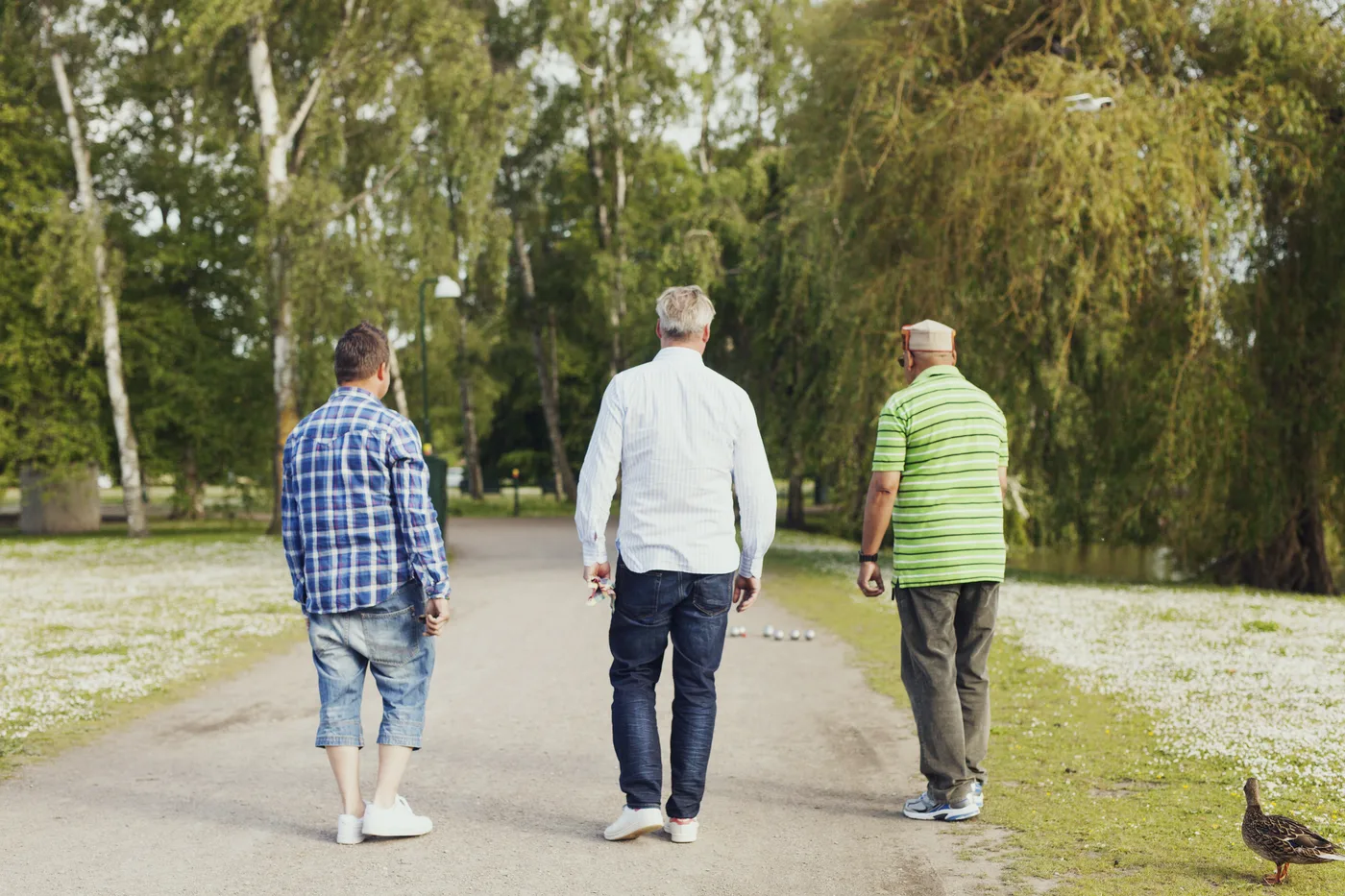
Men tend to do best side by side, with a shared thing to look at, and you can use that. Invite toward an activity that has its own shape: a walk with a destination, coffee early enough that the day has not started shouting, a repair one of you has been putting off, a drive to pick something up. The activity does what the drink used to do. It gives the hands a task, the conversation a rhythm, and the pauses a cover story. Nobody has to perform openness; it arrives on its own somewhere in the second mile.
At the bar itself, the move is one plain sentence. I'm good with a coffee tonight. Said once, without a speech attached, it almost always lands without comment, and more often than you would guess another man at the table quietly does the same. Most men are not committed to the drinking. They are waiting for someone else to go first.
And keep whatever you actually love. If the Friday bar night is a genuine pleasure, this is not an argument against it. The aim is not subtraction. The aim is that your friendships should not have a single point of failure, one substance carrying the whole weight of your being known.
The point was never the beer. It was the sitting down, the hour fenced off from usefulness, the company of someone who knew you before you were whoever you are now obliged to be. The drink has been doing a job for you, competently, for years. Learn what the job is, and you will find you can do a good part of it yourself. Which means you can do it anywhere, at any hour, with nothing in your hand at all.

Loading comments…