
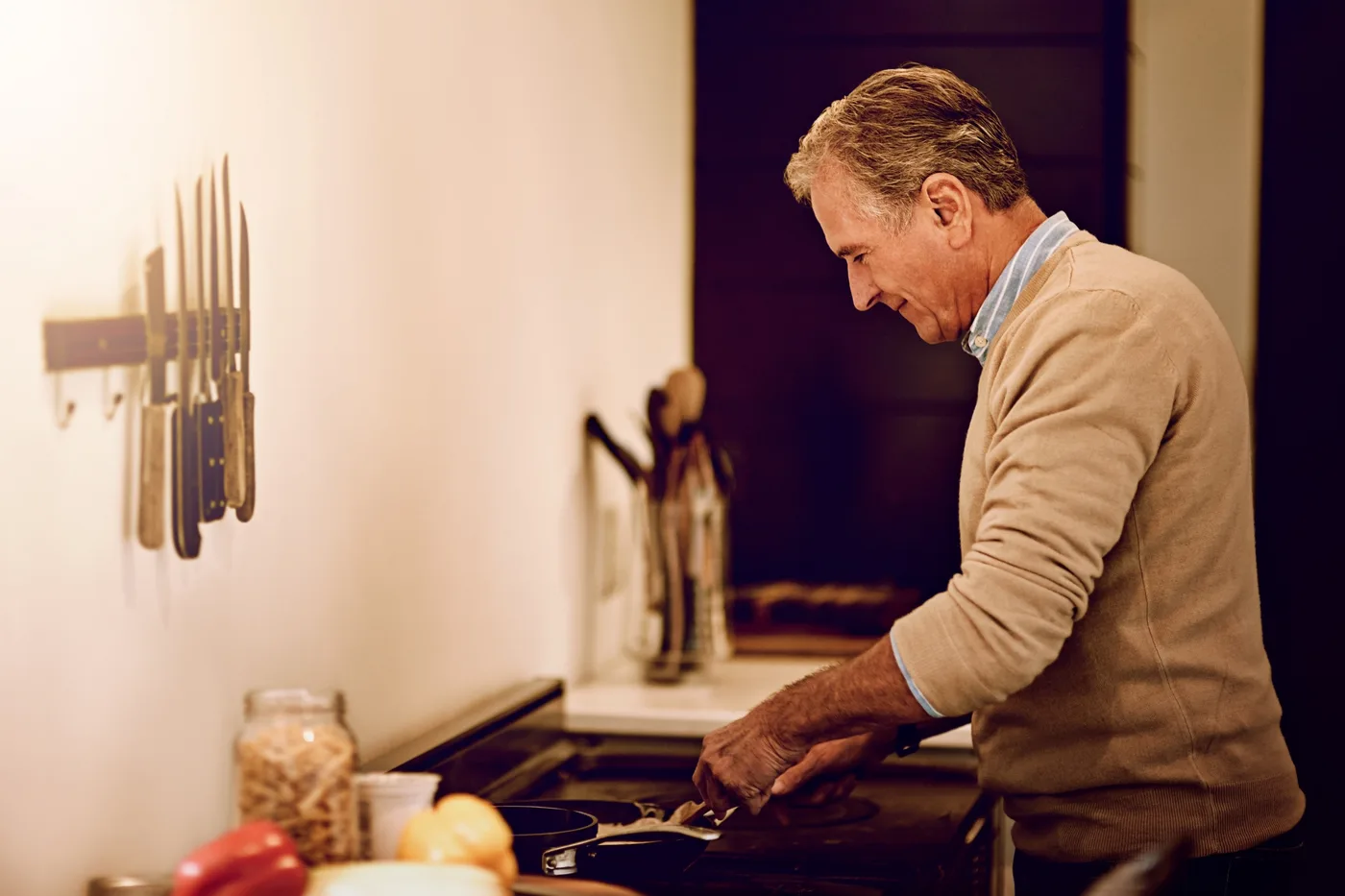
There is a particular quiet in the kitchen of a man who never learned to cook. The appliances work. The pans, if they exist, are clean. The refrigerator holds condiments, something from a deli, and the evidence of a takeout habit that has quietly become the whole system. He is not helpless anywhere else in his life. He can rewire a lamp, read a contract, back a trailer down a ramp. But the room where he is fed has always belonged to someone else, and somewhere along the way he accepted that it always would.
How the room was lost
For a lot of men, especially those raised before the food channels made chefs into athletes, the kitchen was simply never offered. Cooking was cast as someone else's department, and a boy could grow to adulthood having absorbed a thousand hours of lawn care and engine talk without once being shown how to feed himself beyond survival. The result is not a missing skill so much as a missing permission. The grill was permitted, once or twice a summer, fire being acceptably masculine. The stove was not.
The bill for that arrangement arrives late, and it is steep. Researchers who study men living alone after divorce or the loss of a spouse keep finding the same thing: diet quality drops, meals get skipped or outsourced, and eating becomes something done standing up, quickly, without pleasure. A man who cannot cook is one life event away from being fed entirely by packaging. That is not a moral failing. It is what happens when an essential competence was assigned away decades ago and never reclaimed.
And the losses are not only nutritional. Cooking is one of the oldest ways humans care for one another, and a man who cannot do it is locked out of a whole language of care: the meal made for a sick friend, the breakfast made for grandchildren, the dinner that says welcome without needing to say anything. He can receive that language. He cannot speak it.
The three-dish repertoire
Here is the reframe that changes everything: you do not need to learn to cook. You need to learn to cook three dishes. Not thirty, not a cuisine, not knife skills as a discipline. Three dishes, owned completely, cooked so many times that they need no recipe and survive your worst day. Three is a repertoire. Three is self-reliance. Most home cooks you admire rotate through a core barely larger than that.
Choose them by job, not by ambition. The first is the weeknight dish, the one that gets you from hungry to fed in under forty minutes with food that is actually good: a pot of soup, a pasta with things in it, eggs that are more than scrambled, a stir-fry from whatever the drawer holds. The second is the pot that feeds days, something that improves as leftovers: a chili, a stew, a sauce made in quantity, a Sunday pot roast. The third is the company dish, the one you can set in front of people you love without apologizing: a roast chicken is the classic for a reason, it is forgiving, it looks like an occasion, and the house smells like competence for hours.
Pick versions that appeal to you personally, because you will be eating them dozens of times, and that matters more than any other selection criterion. A dish you are curious about will get cooked. A dish chosen because it seemed sensible will not.
Repetition is the recipe
The method is repetition, and this is where cooking turns out to suit how men of a practical bent already like to learn. You do not master a dish by reading about it. You master it the way you mastered anything with your hands: by doing it, noticing what happened, and adjusting the next attempt. Cook the same dish weekly and something remarkable happens around the sixth or eighth time. You stop reading the recipe. You start smelling when the onions are ready instead of timing them. You salt, taste, and salt again, which is the entire secret of restaurant food. The dish stops being instructions you follow and becomes something you know, the way you know the sound of your own engine.
The early attempts will be mediocre, and they should be eaten anyway, standing in your own kitchen, as tuition. Overcooked is information. Bland is information. The tenth chicken is not better than the first because you found a better recipe. It is better because you have been paying attention to the same thing for ten weeks, and attention, it turns out, is the main ingredient the takeout container can never include.
There is also something in the practice itself worth naming. Cooking is one of the few tasks left that asks for your hands, your senses and your presence all at once, and gives you a result you can eat within the hour. Men who take it up late in life often say the same surprising thing: the half hour at the stove became the calmest part of the day. The knife work is rhythmic. The pan demands just enough attention to crowd out the day's residue. It is not called stress relief on any label, but it functions like it.
What the food does for you
The practical returns compound quietly. A man who cooks controls what he eats at the level that actually matters: the salt, the portion, the vegetables that appear because he bought them and they are looking at him. Nothing in a repertoire of three home-cooked dishes needs to be health food to be a substantial upgrade on a rotation of takeout and bar food. This is not a diet, and it makes no medical promises; if a clinician has you on a specific eating plan, that conversation comes first. It is simply the difference between being fed by a business and being fed by someone with your interests at heart, namely you.
And the social returns are larger than most men expect. To cook for someone is to make an offer that flowers and phone calls cannot quite make. The company dish exists for this. A grown son at your table eating your chicken is having a different visit than one where you both stared at menus. A friend going through it, handed a container of your chili, has been told something without either of you enduring a speech. The repertoire is small, but what it lets you say is not.
Starting this week
So: this week, pick the first dish. Just the weeknight one. Buy its ingredients twice, because you are cooking it twice this week, and the second time is where the learning starts. Accept that attempt one is tuition. Put a date on the calendar a couple of months out, and invite someone to eat attempt ten.
The kitchen was never actually someone else's room. It is the room where a person takes care of himself and the people he loves, three dishes at a time, and it has been waiting for you longer than you think.



Loading comments…