
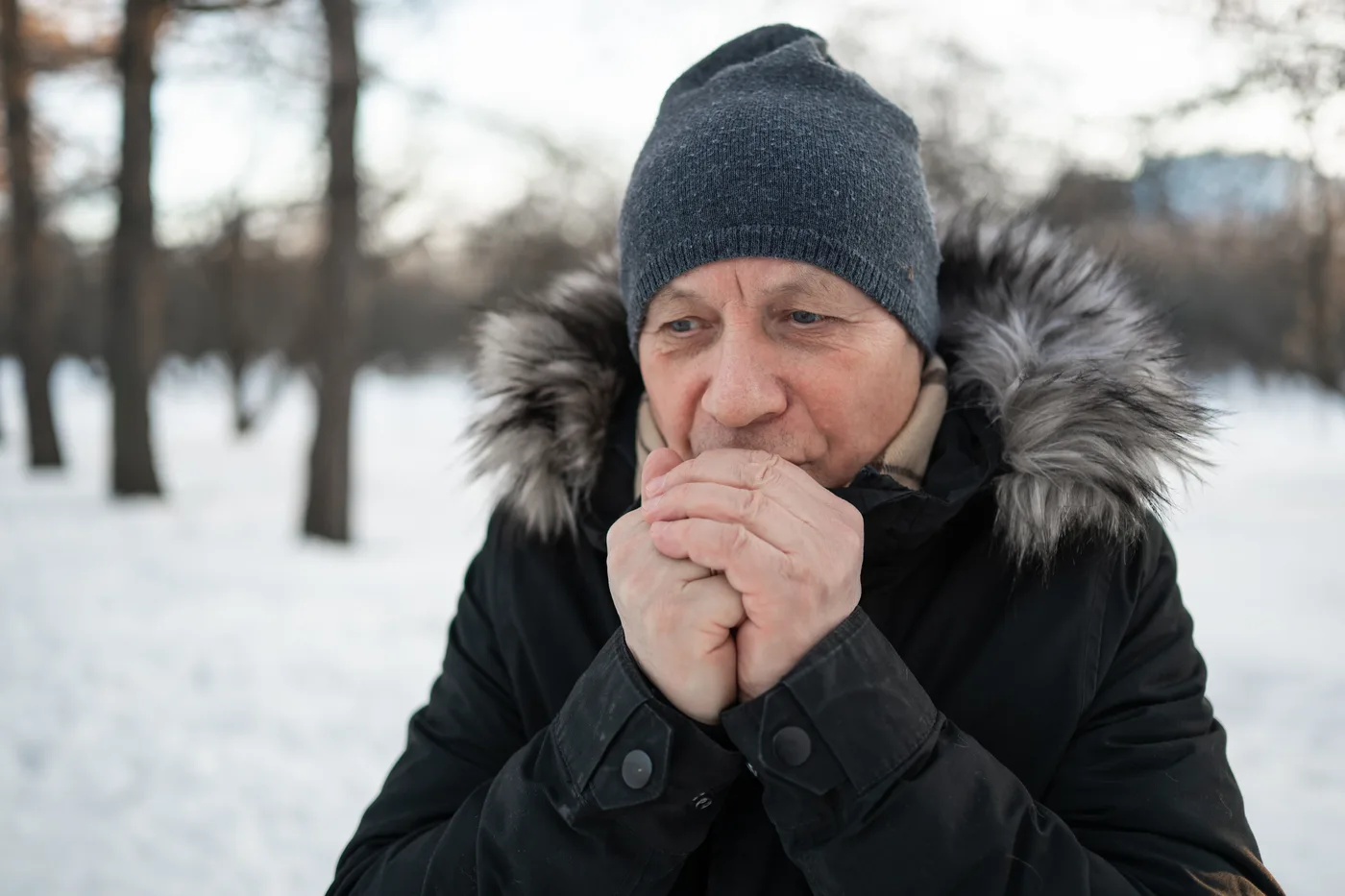
Notice where your shoulders are right now. If you have been outside this morning, or sitting in a room that has not quite warmed up, there is a fair chance they are an inch or two higher than they need to be, pulled up and slightly forward, as if you were bracing for a gust of wind that never arrived. You probably did not decide to do this. The cold decided for you, and your body has been quietly holding the position ever since.
What the body does when it gets cold
When the air turns sharp, the body's first priority is to protect its core warmth. Blood vessels near the skin narrow so less heat escapes, which is why your fingers and nose feel the cold first. At the same time, you instinctively make yourself smaller. The head drops a little, the arms draw in, and the shoulders rise to close the gap around the neck, where large blood vessels run close to the surface.
It is a sensible reflex. Curling up reduces the surface you expose to the air, and tensing muscles produces a little heat of its own. Shivering is the extreme version of the same idea: rapid, involuntary contractions whose whole purpose is to warm you.
The trouble is that the shrug is built for a moment, not a season. Step outside to walk the dog, scrape a windshield or wait for a train, and the shoulders go up. Come back inside, and very often they stay up. By January many people are carrying a low, constant contraction across the tops of the shoulders and the back of the neck, and they have stopped feeling it as tension. It just feels like winter.
The cost of bracing
Muscles are made to contract and release. Held in one position for hours, they tire. The muscles that lift the shoulders run up into the neck and the base of the skull, so a long, slow shrug tends to show up as stiffness when you turn your head, a tight band across the upper back, or the kind of ache that settles in behind the eyes by late afternoon.
There is a quieter cost too. The posture of bracing is the posture of guarding, and the body does not fully separate the two. Raised shoulders and a shortened breath are part of the way we stand when we expect trouble. Many people find that when their shoulders finally drop, something else lets go with them: the breath gets lower and slower, and the day feels a little less like something to be endured.
None of this is dramatic, and that is the point. It is a small physical habit, repeated thousands of times between November and March, and small habits repeated that often are worth some attention.
Warm the neck, and the shoulders can rest
The simplest fix is also the oldest: a scarf. The shoulders rise to protect the neck, so if the neck is already covered, they have far less reason to climb. A soft scarf worn close, or a collar that actually closes, does a surprising amount of the work your muscles have been doing.
The same logic applies everywhere the body is guarding. A hat keeps heat in so you hunch less. Gloves let you take your hands out of your pockets, and hands jammed into pockets tend to push the shoulders up and forward. A coat that is warm enough means you are not clenching against the cold for the whole walk. Dressing well for the weather is not only about comfort. It is about letting your body stop defending itself.
The drop
Once you are warm, the shoulders need a reminder that the danger has passed. Here is a practice that takes about fifteen seconds and works best done often.
Lift on purpose. Breathe in and deliberately raise your shoulders toward your ears, higher than they already are. Hold them there for a slow count of three. Notice what the effort feels like.
Let them fall. Breathe out and let the shoulders drop all at once, as if someone had cut a string. Do not lower them carefully. Let gravity do it.
Rest in the new place. Take one more easy breath and notice where your shoulders have landed. For many people it is noticeably lower than where they started, which tells you how much you had been holding without knowing it.
Tensing a muscle before releasing it is a long-standing relaxation technique, and it works partly because it teaches you the difference. After a few rounds, you start to recognize the raised position for what it is, and you catch it sooner.
Give the habit a few anchors
The shrug creeps back. It will rise again the next time you step outside, and that is fine. The aim is not to fight it in the cold, but to remember to release it afterward. Some people find it helps to tie the drop to moments that already happen every day.
Every doorway in from outside. Coat off, shoulders down. It becomes as automatic as wiping your feet.
Every red light, if you drive. Cold steering wheels and dark early commutes are a reliable recipe for a raised, gripping posture.
The first sip of something warm. You are already pausing. Let the shoulders pause with you.
The shower. Let warm water run across the tops of your shoulders and the back of your neck for a minute before anything else. Warmth tells those muscles what words cannot.
Moving through the cold instead of bracing against it
One more thing changes the experience of winter more than most people expect: moving with the body rather than holding it still. A brisk walk with the arms swinging naturally warms you from the inside and gives the shoulders something to do besides clench. Rolling the shoulders slowly backward a few times while you wait for a bus, or reaching your arms overhead before you sit down at a desk, reminds the upper body that it is allowed to be open.
If you sit for long stretches, check the room. A desk near a drafty window, or a thermostat set low to save money, can keep the shrug going all day indoors. A small rug under cold feet or a sweater over the shoulders can be worth more than another layer of willpower.
And if the tension does not ease, or comes with numbness, tingling, frequent headaches or pain that wakes you, that is something to bring to a doctor or physical therapist. A seasonal habit is one thing; an ongoing problem deserves real attention.
Coming down
There is something tender about the winter shrug once you see it. It is your body trying to keep you safe, doing exactly what it was built to do, a little too faithfully. You do not need to scold it. You only need to let it know, a few times a day, that you are warm now, the wind has passed, and it can set the weight down.
Try it once more before you go. Lift. Hold. Let them fall. Then notice how much room there is between your shoulders and your ears, and how much of the season you might spend there instead.



Loading comments…