
There is a second circulation running through you, roughly twice the volume of your blood, and almost nobody thinks about it until an ankle swells or a therapist mentions it in passing. It has no pump. Nothing drives it but your breathing, your muscles and the ordinary movement of your day, which means it is one of the few systems in the body that genuinely waits on you to do something before it will do its work.
The Circulation Without a Heart
Blood has it easy. There is a muscular pump at the center of the chest pushing it out under pressure, and a closed loop bringing it home, and none of it requires your participation.
The lymphatic system runs alongside all of that, and it works completely differently. Picture a network of very fine vessels, finer than the smallest blood vessels, threaded through nearly every tissue you have. They begin as open ends out in the tissue, they collect what the bloodstream leaves behind, and they carry it slowly upward and inward, through several hundred lymph nodes, until it empties back into the bloodstream near the collarbone.
What it carries is the part people rarely hear. Every day your capillaries leak a considerable amount of fluid into the spaces between your cells. That is not a fault, it is how your cells are fed and bathed. But most of that fluid has to be collected again, along with proteins too large for the blood vessels to take back, along with cellular debris, along with the fats absorbed from your last meal, along with immune cells traveling to where they are needed. The lymphatic system is the collection service for all of it.
Which is why the older description of it as a drainage system, while not wrong, sells it short. It is closer to a tide. It moves through the tissue, gathers what needs moving, and delivers it somewhere it can be dealt with.
What Moves It
Here is the part that changes how you think about your day.
The larger lymph vessels do have a gentle contraction of their own, and one-way valves so nothing travels backward. But the great majority of the movement comes from outside the vessel. It comes from skeletal muscle squeezing around it every time you take a step or reach overhead. It comes from the changing pressure inside your abdomen and chest as you breathe, which is why the deep breath is not a metaphor here but a mechanical event. It comes from the pulse of the arteries running beside the vessels. And it comes from movement of the skin itself, which is where the finest vessels sit, so close to the surface that light pressure is enough to affect them.
None of those things happen when you sit still. This is the whole reason your ankles are thicker after a long flight and your hands feel puffy after a night lying flat and your face looks different at seven in the morning than it does at noon. Fluid follows gravity and waits for movement, and if the movement does not come, it stays where it is.
The practical version of that is short. Your lymphatic system is asking for very little. It is asking you to breathe deeply, move often, and not stay in one shape for hours at a time. It is arguably the most responsive system in the body to the smallest interventions, and the one most reliably neglected by a life lived at a desk.
The Nodes Are Not Waiting Rooms
Along the way, all of that fluid passes through lymph nodes, which cluster in the neck, the armpits, the groin, the abdomen and behind the knees. Most people meet theirs once, as swollen glands during a sore throat, and file them under something that goes wrong.
They are not passive filters. A node is a densely packed meeting place where immune cells sit waiting, and where fluid arriving from the tissue is examined. If it carries something the body wants to respond to, the response begins there, and the swelling you can feel under your jaw is the node populated and working. It is one of the few times the immune system announces itself in a way you can put a finger on.
Once you know that, the geography starts to make sense. The nodes cluster at the junctions, at the neck and the armpit and the crease of the hip, which are exactly the places the body folds and where movement naturally compresses tissue. The design assumes a body that bends.
When the Tide Slows
Most of us have a lymphatic system that is simply sluggish, in the ordinary way that comes from long sitting, shallow breathing, tight clothing at the waist and hip, dehydration and not much movement of the arms above the heart. It shows up as puffiness that comes and goes, as heaviness in the legs by evening, as a face that takes a while to look like itself.
There is also a genuine medical condition, lymphedema, where the system has been damaged or was never fully formed, and fluid accumulates persistently in a limb rather than coming and going. It is common after surgery or treatment that involves the lymph nodes, particularly around the breast and the pelvis, and it is not something to manage with general wellness advice. It has its own specialty, certified lymphedema therapists, and specific techniques and garments that work well. If you have swelling in one limb that does not resolve overnight, or a limb that feels heavy and tight and different from its partner, that is a conversation with a clinician rather than a reason to try dry brushing.
Worth saying plainly, because this system attracts a great deal of extravagant language: the lymphatic system does not detoxify you in the way the word is usually used. Your liver and your kidneys do that work, and they do it whether or not you have bounced on anything. What the lymphatic system does is move fluid, transport fat, and carry immune traffic, and moving it well is genuinely worth doing. It just does not need to be oversold to be worth your attention.
The Things That Actually Help
Almost everything on this list is free, and most of it takes less than five minutes.
Breathe into your belly, deliberately, a few times a day. The diaphragm dropping and rising changes the pressure in the abdomen and chest, and the largest lymphatic vessel in the body, which runs up through both, is directly affected by it. Ten slow breaths lying on your back, one hand on the belly, feeling it rise. This is the single most direct thing you can do and it requires nothing.
Move every hour, even briefly. Not a workout. Standing up, walking to another room, thirty seconds of reaching overhead. The system responds to frequency more than intensity, and an hour is roughly the interval at which sitting starts to cost you.
Walk. The calf muscles squeezing rhythmically around the deep vessels of the leg are the closest thing this system has to a second heart, which is exactly why the legs are where fluid settles when the walking stops.
Put your legs up the wall. Lie on your back, legs resting vertically against a wall, five to ten minutes. Gravity, which has been working against the return flow all day, briefly works with it. It is also one of the more reliably calming things you can do with your body in the evening.
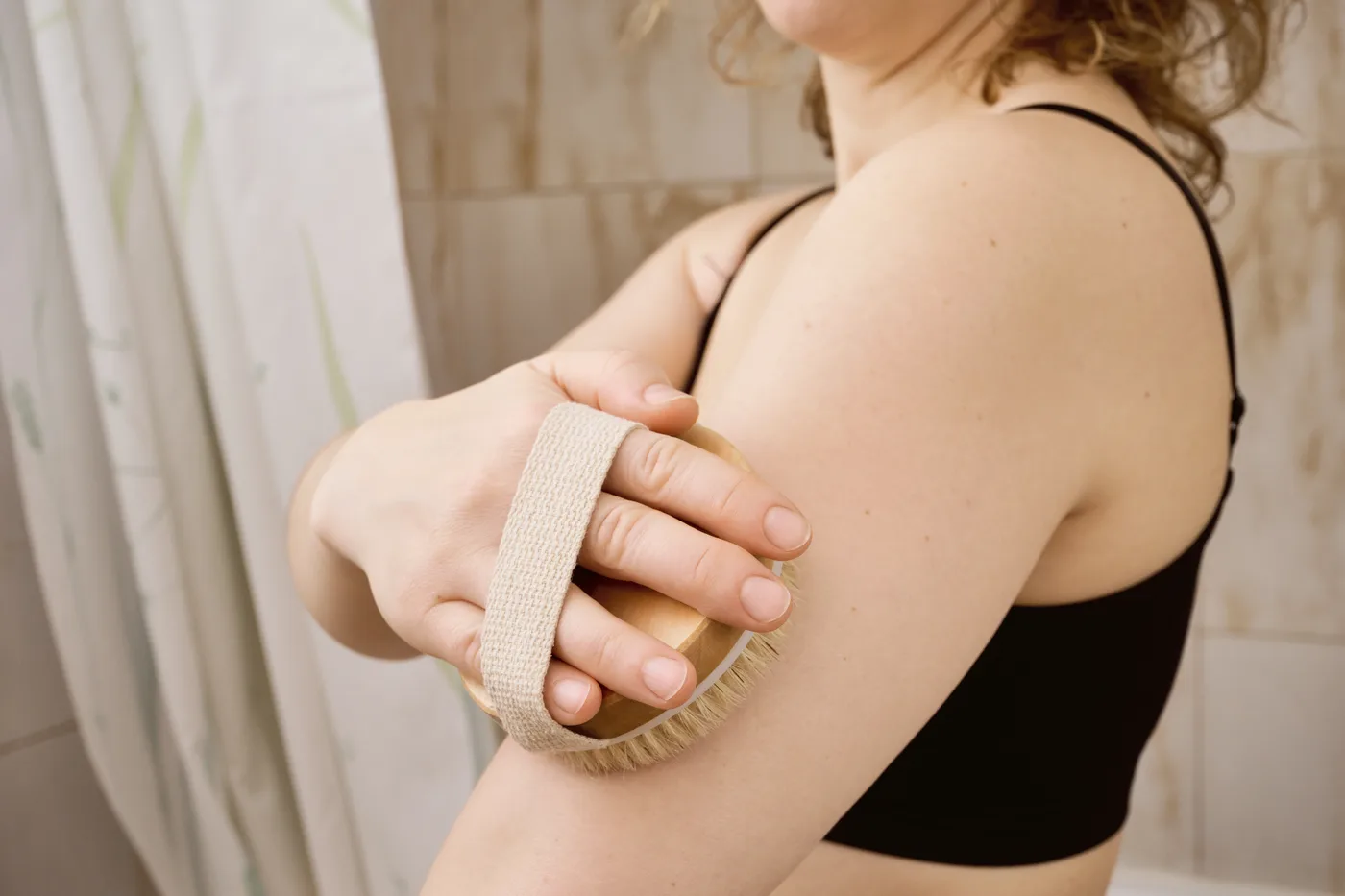
Try dry brushing, gently and toward the heart. A soft natural bristle brush on dry skin before a shower, light strokes, always moving toward the center of the body, starting at the feet and hands. The vessels involved sit just under the skin, so the pressure needed is much lighter than instinct suggests. If your skin is red afterward you have pressed far too hard. It is pleasant, it wakes up the surface, and it takes three minutes.
Finish your shower cool. Thirty seconds of cooler water at the end causes vessels to constrict and then dilate as you warm, and the change in tone assists the movement. It also does something clarifying to the mood that has nothing to do with fluid.
Drink enough water. Lymph is mostly water. A system asked to move fluid through fine vessels does not do it well when there is not enough to go around, and thirst is a late signal rather than an early one.
Loosen what is tight. Waistbands that leave a mark, socks with a deep band at the calf, an underwire that presses into the side of the chest all sit exactly where the vessels and nodes are. Not a catastrophe, but worth noticing, and worth changing at the end of a day rather than sleeping in.
Consider bodywork with intention. Manual lymphatic drainage is a real, trained technique, and it is remarkably light, closer to a slow stretch of the skin than a massage. If someone is working deeply into your muscle and calling it lymphatic drainage, they are doing something else, which may be lovely and is not this.
Sing, laugh, hum. All of them move the diaphragm vigorously and irregularly, which is a better mechanical event than a tidy breath. There is a reason a long laugh leaves the whole torso feeling different.
A Body That Bends
What is quietly interesting about all of this is how much it asks for, and how little.
Every other major system runs on its own. Your heart does not require your cooperation. Your kidneys are not waiting for you to stretch. The lymphatic system alone is built on the assumption that you will move, that you will breathe fully, that you will bend and reach and walk and lie down and get up again, and that this will happen many times a day without anyone scheduling it.
We built a way of living that makes almost none of that automatic. So the system waits, and the fluid settles, and by evening you can feel it in your legs and your hands and around your eyes, and it is easy to read that as age when a good deal of it is simply stillness.
Tonight, before bed, lie down with your legs up the wall and take ten slow breaths into your belly. It costs you five minutes. Notice how your legs feel when you stand up. That is the tide, moving, because you finally asked it to.
Loading comments…