
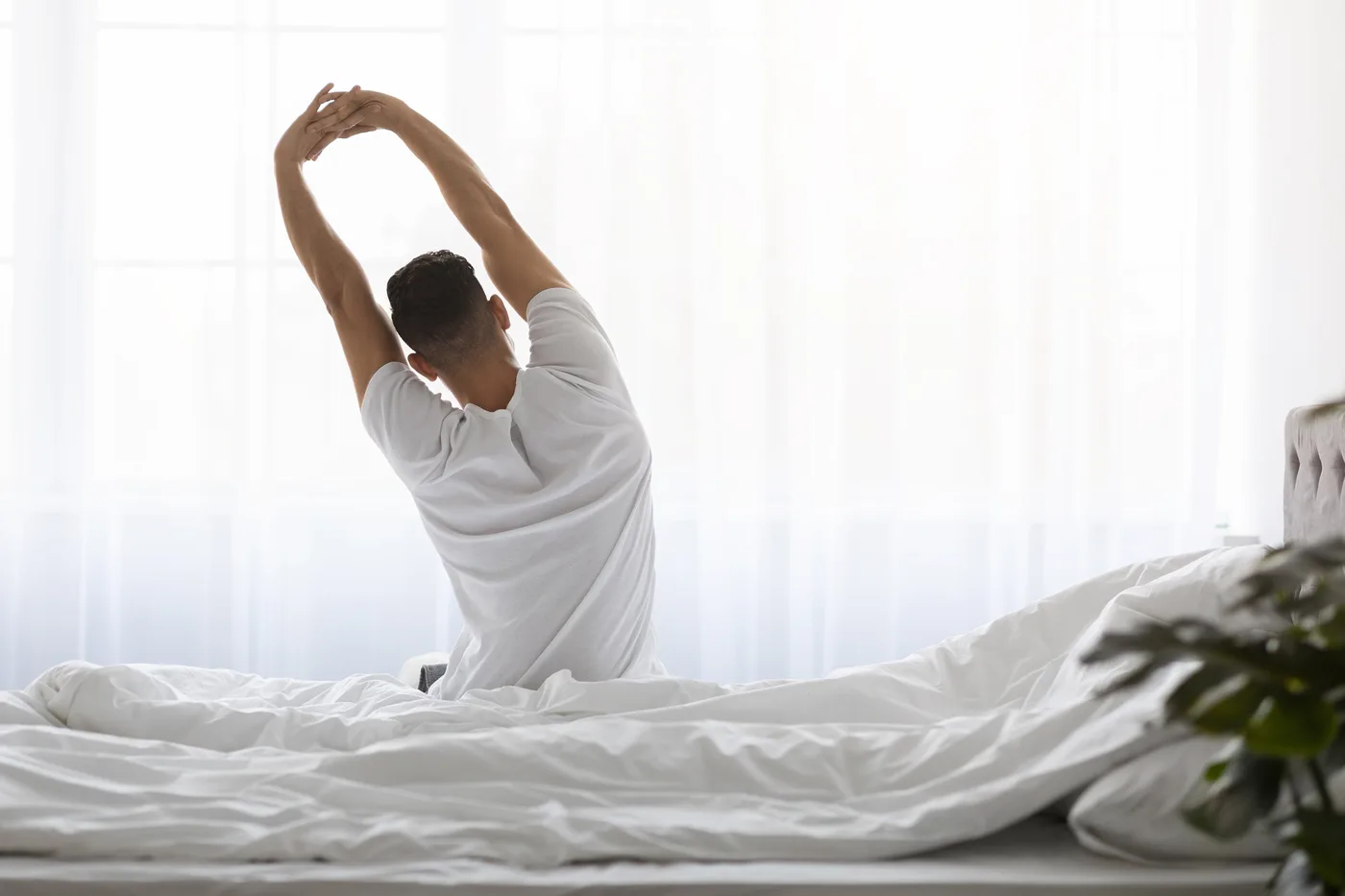
You do it before you decide to. The alarm goes, or the light does it for you, and somewhere between asleep and awake your arms travel up over your head, your spine lengthens, your jaw opens into a yawn you did not order, and for three or four seconds your whole body pulls taut like a sheet being snapped over a bed. Then it lets go, and you are awake in a way you were not a moment before. It is one of the oldest things you do all day, and most of us have never once asked what it is for.
The stretch has a name
Scientists call that involuntary morning reach pandiculation, and it is not a human habit so much as an animal inheritance. Cats do it rising from a nap, extending each leg with ceremonial attention. Dogs bow into it. Birds do a version with one wing and one leg at a time. Researchers watching ultrasound images have seen babies doing it in the womb, arching and reaching months before there is any morning to wake up to.
Something that widespread and that ancient is not decoration. The best current understanding is that pandiculation is a transition ritual for the nervous system: a way of rousing the muscles from rest, reintroducing the brain to the body it is about to operate, and resetting the resting tension in tissues that have been still for hours. You are not just moving your muscles. You are taking attendance.
That reframe matters, because it moves the stretch from the category of "flexibility training" into the category of things like sleep and appetite: a signal from the body about what it needs, delivered without words, and available to be worked with on purpose.
What stretching does not do
The folk model of stretching is mechanical. Muscles are rubber bands, the story goes, and stretching pulls them longer, and a longer band is a healthier one. It is a tidy picture, and it is mostly wrong.
When researchers have measured muscles before and after weeks of dedicated stretching programs, the tissue itself changes far less than the model predicts. What changes most is something subtler: how far the nervous system will let you go. Physiologists call it stretch tolerance. Your muscles are threaded with sensors called spindles that report their length to the spinal cord many times a second, and when a stretch goes further or faster than the system trusts, a protective reflex tightens the muscle against it. That reflex is why bouncing into a stretch fights you, and it is why the limit you feel in a hamstring is less like the end of a rope and more like a guard at a door.
Regular, gentle stretching does not so much lengthen the rope as reassure the guard. The range was there all along. What you gain, mostly, is permission.
This is quietly good news. It means the stiffness you feel on waking, or after three hours in a chair, is not your body wearing out in real time. It is largely a setting, a level of protective tension the nervous system has chosen based on what you have been doing, which for most of us is sitting very still. Settings can be adjusted. That is what the morning stretch is doing, unbidden, every day.
Why it feels the way it feels
Nobody needs to be persuaded to enjoy a good stretch, but it is worth noticing what the pleasure is made of. Part of it is simple contrast: movement arriving after stillness, blood moving through tissue that has been quiet all night. Part of it is the yawn, which so often comes bundled with the reach that scientists study them together.
And part of it seems to be the reintroduction itself. Your brain keeps a running map of where your body is, built from those same length sensors in muscle and tendon, and after hours of stillness the map goes slightly stale. A full-body stretch lights up the sensors all at once, and the map redraws. People often describe the moment after a real stretch as feeling more located, more inside themselves, and that description may be closer to the physiology than it sounds.
What the stretch will not reliably do is the job it is most often assigned. Decades of studies on static stretching before exercise have not shown much protection against injury, and long holds right before explosive effort can briefly blunt strength. If you have been stretching all these years to earn insurance, the research is underwhelming. But that was never the real reason. The real reason is the one the cat has.
A two-minute practice
Here is the practice, and it is almost embarrassingly small: give the stretch two minutes instead of four seconds, and give it your attention instead of your autopilot.
Before you pick up the phone, while you are still in or on the bed, do deliberately what your body just did on its own. Reach the arms long overhead and push gently through the heels, so the whole line of you lengthens at once. Let the jaw go; if a yawn arrives, let it happen, since it is part of the mechanism rather than an interruption. Then move slowly through whatever the body suggests: knees dropping to one side, a curl forward over the legs, shoulders rolling back. Nothing held long, nothing forced, nothing counted.
Two rules keep it honest. Stretch to the place where you feel it, never to the place where you brace against it. The moment you are gritting or bouncing, the guard at the door has planted its feet, and you are now negotiating with a reflex you cannot win against. And exhale into the far end of each shape, because a long slow breath out is one of the few signals the protective system reliably reads as safety.
The same practice works in miniature at a desk. Three hours into a sitting afternoon, the reach you feel like doing is the same message in the same language, and it deserves the same thirty seconds of cooperation.
What to expect, honestly
Expect the transition, not a transformation. A body that starts the day with two attended minutes of movement tends to arrive in the kitchen feeling less like a piece of furniture and more like an animal, and that difference, small as it is, colors the hour that follows. Over weeks, most people find they move a little more freely, which is the nervous system extending its trust, not new muscle length, and it is no less real for that.
Do not expect it to fix pain. Ordinary morning stiffness that eases with movement is one thing; pain that sharpens, persists, or wakes you is a different message entirely, and the answer to it is a clinician, not a longer hamstring hold. Nothing here is a substitute for that visit.
The larger shift is in how you stand toward the signal itself. The urge to stretch is your body asking for something specific and cheap, one of the few requests it makes in plain language. Most of us override it a dozen times a day, the way we override the urge to look out a window. Granting it costs two minutes at dawn and thirty seconds in the afternoon.
Tomorrow morning the reach will come for you again, uninvited, the way it came for you in the womb. Before your feet find the floor, before the day gets its hands on you, let the animal finish its sentence.



Loading comments…