
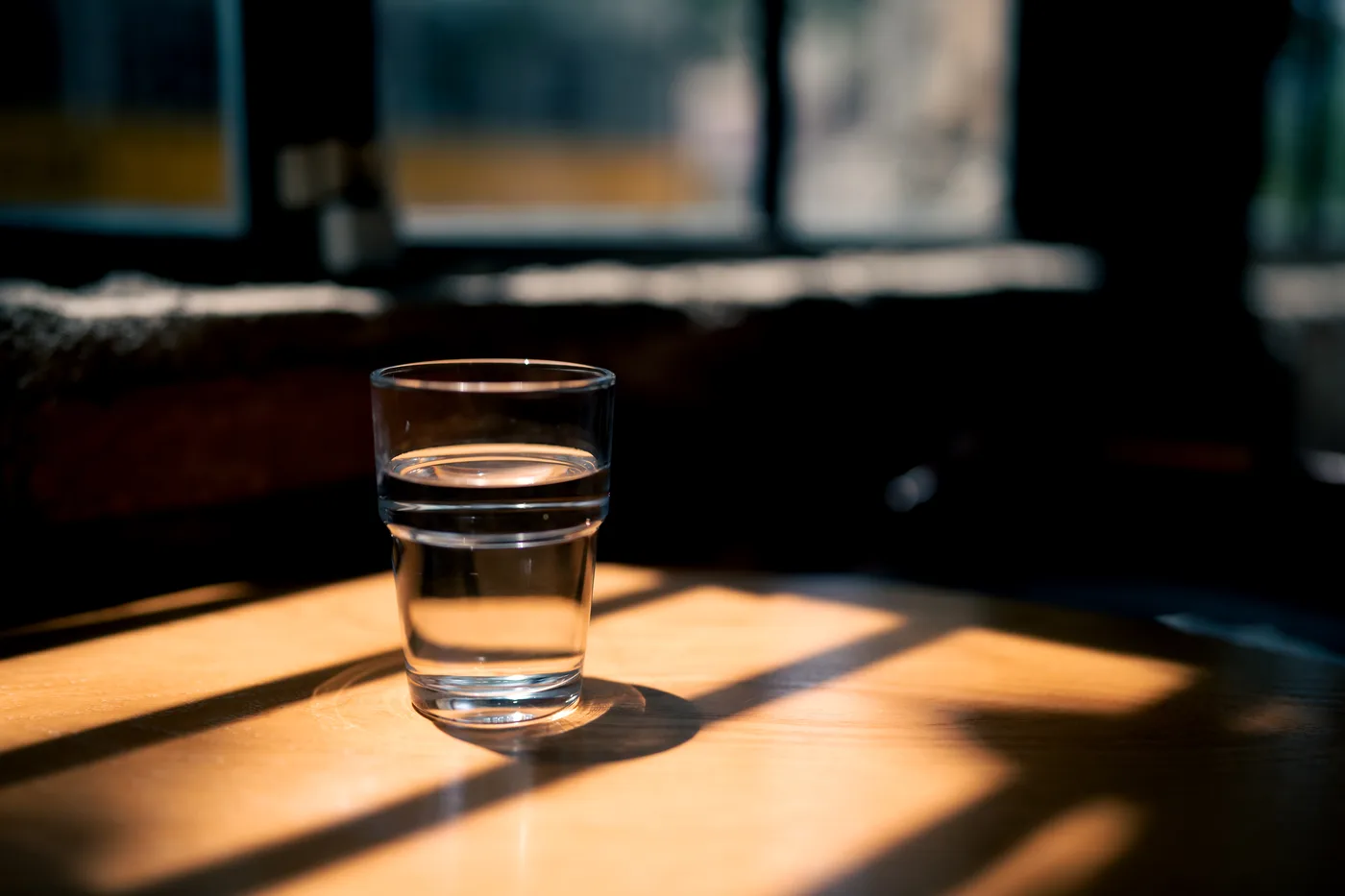
Somewhere along the way you learned the number, the way you learned that lightning never strikes twice: eight glasses of water a day. It travels with a companion claim, that by the time you feel thirsty you are already dehydrated, and together the two have sent a generation out the door with a liter of stainless steel under one arm and a low hum of guilt about every glass not drunk. Here is the strange part. Nobody can quite say where the number came from, the research behind it is thinner than almost anyone assumes, and the instrument that actually manages your water, one of the oldest and best calibrated systems in your body, has been quietly doing the job all along.
Where the number came from
Trace the eight glasses back and the trail goes cold in the middle of the last century. The usual suspect is a 1945 recommendation from an American nutrition board suggesting that adults need roughly two and a half liters of water a day, which does indeed work out to about eight glasses. But the recommendation had a second sentence, and the second sentence changed everything: most of that quantity, it noted, is already contained in food. The number survived the decades. The sentence did not. What began as a description of total water from every source, the soup and the peach and the morning coffee included, hardened into a prescription for eight additional glasses of plain water, a rule with the durability of scripture and roughly the same relationship to evidence.
Researchers who have gone looking for the science behind eight-a-day have come back essentially empty-handed. Which is not to say water does not matter; it matters absolutely. It is to say that the specific arithmetic, eight glasses, sixty-four ounces, everyone, every day, regardless of body, climate or breakfast, was never a finding. It was a rounding error that got famous.
The instrument you already own
Meanwhile, consider what your body is doing about the question. The saltiness of your blood is monitored continuously by sensors in the brain that respond to changes of less than one percent. Drift slightly toward dry and a cascade begins: a hormone tells the kidneys to conserve, the urine concentrates, and the sensation of thirst is switched on and aimed at your attention. Drink, and the whole system relaxes, often within minutes. This is not a crude alarm that fires late. It is a fine instrument, tuned over a very long time, and for a healthy adult living an ordinary day it is remarkably good at its one job.
The companion claim, that thirst arrives only after dehydration has already done its damage, misreads the machinery. Thirst switches on early, at the first meaningful drift, which is the system working exactly as designed: you notice, you drink, the line comes back to center. The healthy body is not a bucket with a slow leak that must be preemptively topped up. It is a thermostat, and a good one.
And the ledger it balances is wider than the water bottle. Roughly a fifth of what you take in arrives as food, more if you eat like the readers of a magazine with a recipe section: fruit is mostly water, vegetables more so, soup announces itself. The coffee and tea count too. Caffeine's reputation as a dehydrator is another durable exaggeration; its diuretic effect in regular drinkers is mild, and the cup delivers far more water than it costs. The morning coffee is on the intake side of the ledger, not the outflow.
Where the rule of thumb actually helps
Every honest account of thirst has to include the people it serves less well, and they are not rare.
The clearest case is age. The thirst signal quietly loses volume across the decades, so an older adult can genuinely need water and barely feel the prompt, which is one reason heat waves are hardest on the old. Past seventy or so, drinking on a schedule rather than on sensation is not neurosis; it is a sensible workaround for an instrument that has gone soft-spoken. A glass with each meal and one mid-morning and mid-afternoon covers most of it, and for anyone checking on an elderly parent in August, offering the glass matters more than asking whether they are thirsty.
Sweat is the other case. Long exertion in heat can outrun thirst, which is why people who work outdoors or run distances reasonably drink ahead of the sensation. Illness changes the math, with fever and stomach bugs both draining the reservoir. And some conditions and medications rewrite the rules entirely: clinicians tell some patients to drink well beyond thirst and tell others to restrict, and in a kidney, heart or medication conversation the instructions of the person who knows your chart outrank any general essay, this one included.
One more caution, because the culture of maximal hydration has made it necessary: more is not automatically better. It is entirely possible to drink past the body's ability to keep its salts in balance, a state called hyponatremia that shows up occasionally in marathoners and in devotees of extreme water regimens, and it is dangerous. The existence of a gallon jug with motivational time-stamps printed down the side is not evidence that emptying it is wise.
Reading your own gauges
So what does sensible practice look like, for a healthy adult, without arithmetic or guilt?
Trust thirst, and make it easy to answer. The failure mode of modern hydration is rarely a broken signal; it is a signal answered with whatever is nearest, which is often sweetened. Water within reach, on the desk, in the car, by the bed, means the instrument gets an honest response. That is most of the practice.
Glance at the gauge you carry. Urine somewhere in the pale-straw range generally means the system is content; consistently dark and scant means it is conserving, and a drink is due. First-of-the-morning runs darker for everyone, so read the day, not the dawn. This one check, made without ceremony, tells you more about your own hydration than any counted glass.
Let the calendar adjust the defaults. An August afternoon of yard work on Long Island is a different country from a January desk day, and the body's needs can double with heat and effort. Salt lost to serious sweating wants replacing too, which ordinary food handles for all but the longest efforts.
And then, having read the gauges, relax. If plain water bores you, cold from the tap with a wedge of something is a genuine pleasure and counts entirely; so does seltzer, so does herbal tea, so does the melon. Hydration culture has managed to turn the body's most self-regulating need into a performance with equipment and quotas. The quieter truth is that for most healthy people on most days, the whole assignment is: eat real food, keep water nearby, drink when you are thirsty, and check the color once in a while. The instrument is older than the number, and better made. You were never eight glasses behind. You were carrying the measuring cup the whole time, and it was never the steel one.

Loading comments…