
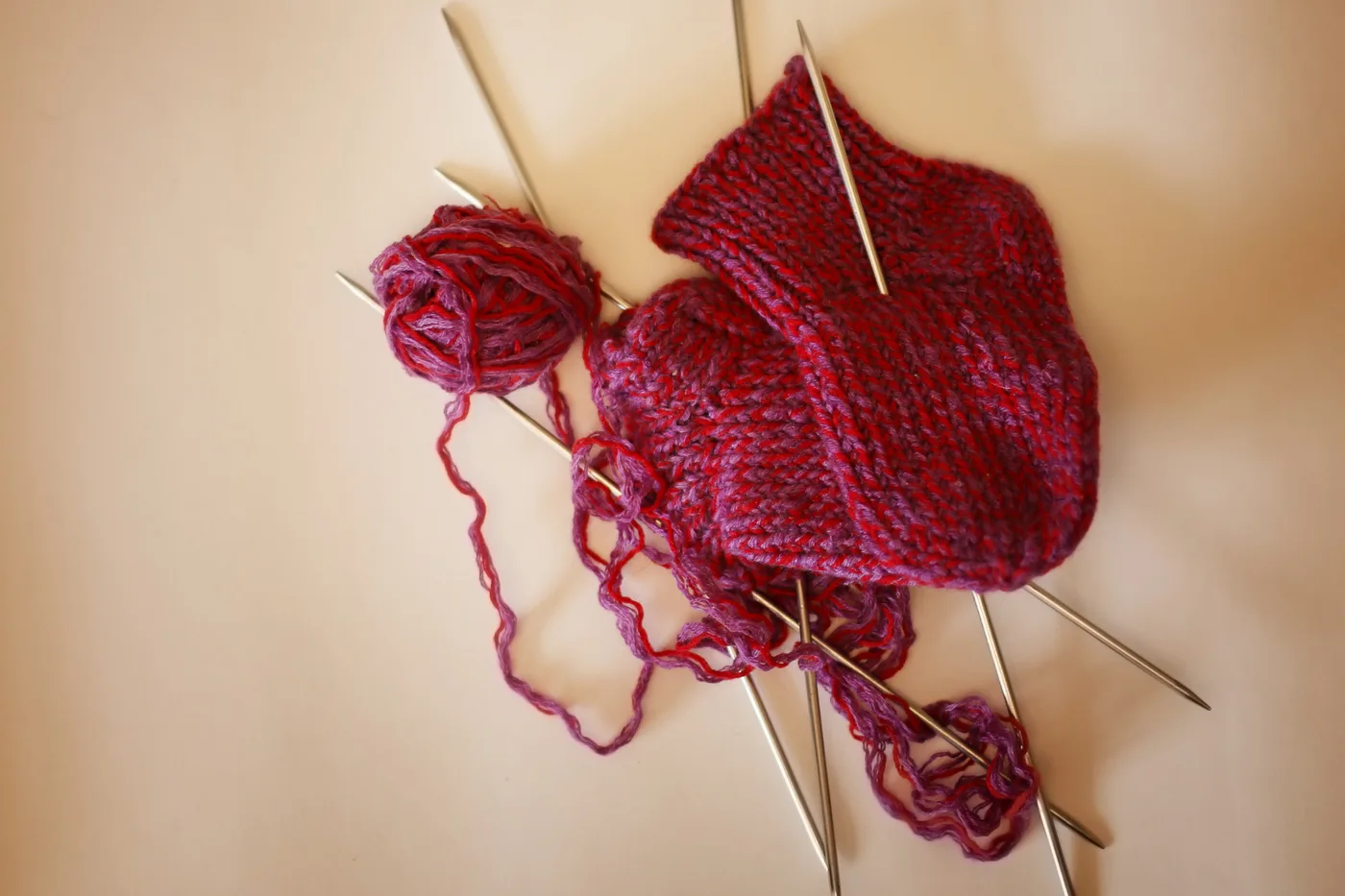
You know the feeling of ending a work session well. The chapter is finished, the row is bound off, the canvas is at a stage you can live with, and you close the notebook with the small satisfaction of a clean break. And you know the other feeling, the next day's feeling, of sitting down to a finished thing and having no idea how to begin again. The two feelings are connected. The clean break is why the blank start is so hard, and the fix is one of the stranger pieces of advice in the whole craft tradition: stop in the middle.
The tyranny of the clean break
Finishing feels virtuous. We are taught to complete things, to leave the desk tidy, to end at the natural pause. So when the paragraph resolves or the sleeve is done, we take it as permission to stop, and we spend the last of the day's energy sprinting to that resolution.
But look at what the clean break actually leaves behind. It leaves a completed unit and an empty road. Tomorrow you must not only start moving again from a dead stop, you must also decide, cold, what the next unit even is. All of the hardest work of a session, the deciding and the warming up, has been pushed onto the version of you with the least momentum: the one who just sat down.
The blank page gets blamed for this, but the page is innocent. The problem is not that nothing is written. The problem is that nothing is owed. A finished stopping point closes every open question, and open questions, it turns out, are the engine.
What an open loop does to a mind
In the 1920s, the Lithuanian psychologist Bluma Zeigarnik noticed something about waiters in a Vienna cafe: they held long, complicated unpaid orders in memory with ease, and forgot them almost the moment the bill was settled. She followed the observation into the laboratory, interrupting people midway through simple tasks, and found the pattern held. Unfinished tasks stayed vivid in memory at roughly twice the rate of finished ones. The effect now carries her name.
The finding has been debated and refined in the century since, as findings are, but the core of it matches something every maker already knows from the inside. An unfinished thing stays warm. The mind keeps a file open on it, returns to it in the shower and on the drive, quietly turning it over. A finished thing is archived, and the warmth is gone by morning.
Stopping in the middle is simply this effect, used on purpose. You leave the loop open so that your own mind will keep paying attention to the work when you are not there.
The practice, plainly
The rule has two halves, and the second is the one people miss.
The first half: end the session before the natural stopping point. Mid-scene, mid-paragraph, even mid-sentence. If you knit, stop partway through a row. If you paint, stop with a passage half-stated. If you write code, stop with the next test failing and the fix already clear in your head. Leave the work visibly, slightly, deliberately incomplete.
The second half: stop while you still know what comes next. This is the part that makes it work. You are not stopping when you are empty, confused, or defeated; that is just quitting with extra steps, and tomorrow you will inherit the confusion along with the cold start. You stop at the moment of certainty, the moment you can see the next three moves. That certainty is exactly the thing you are banking. The novelist's version of the habit, famously associated with Hemingway among others, was to quit for the day only when the next thing to happen was already known.
Before you stand up, spend thirty seconds writing the certainty down. One line: what happens next, where the brush goes, which stitch you are in. Not a plan for the whole project, just the next step, stated concretely enough that a stranger could act on it. Tomorrow you will be that stranger.
What re-entry feels like
The next session begins differently and you will feel it inside a week. There is no decision to make at the desk, because yesterday's you already made it. You sit down, read the one line, finish the open sentence or the open row, and you are moving before doubt has finished its coffee. The half-done thing is a hand extended from yesterday, and taking it requires no courage at all, which matters, because courage is scarce at the start of a session and plentiful in the middle.
There is a second, subtler return. Because the loop stayed open overnight, some portion of the problem got worked without you. You will sit down, some mornings, already knowing the answer to a question you had not consciously asked. This is not mysticism; it is what minds do with open files. The practice just makes sure the right file is the open one.
Where it applies, and where it does not
The practice belongs to anything made across multiple sessions: manuscripts, gardens, quilts, kitchen renovations, long letters, slow paintings, the family history you keep meaning to assemble. Anywhere the real enemy is not difficulty but re-entry, the open loop is the tool.
It is worth being honest about where it does not belong. Some work has to be finished in one push because half-done is dangerous or useless: the tax filing, the medication sorted into the pill organizer, the fence with a gap in it and a dog in the yard. And some sessions genuinely end at zero, with nothing left and nothing known; on those days, stopping in the middle is not available, and the kindest move is to write down the confusion instead, one line about what, exactly, is unknown. Even a well-described confusion is a warmer start than a blank.
There is also a temperament that will resist this on principle, the temperament that cannot sleep with a dish in the sink. If that is you, start small. Leave one sentence unfinished, once, and notice what tomorrow feels like. The discomfort of the open loop is real, but it is the discomfort of a bow drawn back. It is supposed to feel like tension. The tension is the point.
The unfinished house
There is an old idea, found in more than one craft tradition, that a deliberate imperfection is left in the work: the flaw woven into the rug, the unpainted corner. The usual explanation is humility. But there is a practical wisdom under the humility. A thing left slightly open is a thing still alive, still in conversation with its maker, still owed a visit.
That is what you are doing when you cap the pen mid-sentence and walk away. You are not abandoning the work. You are leaving a light on in it. Tomorrow, coming back will not feel like starting. It will feel like coming home to a room where someone is expecting you, and the someone is you, and the kettle, so to speak, is already on.



Loading comments…