
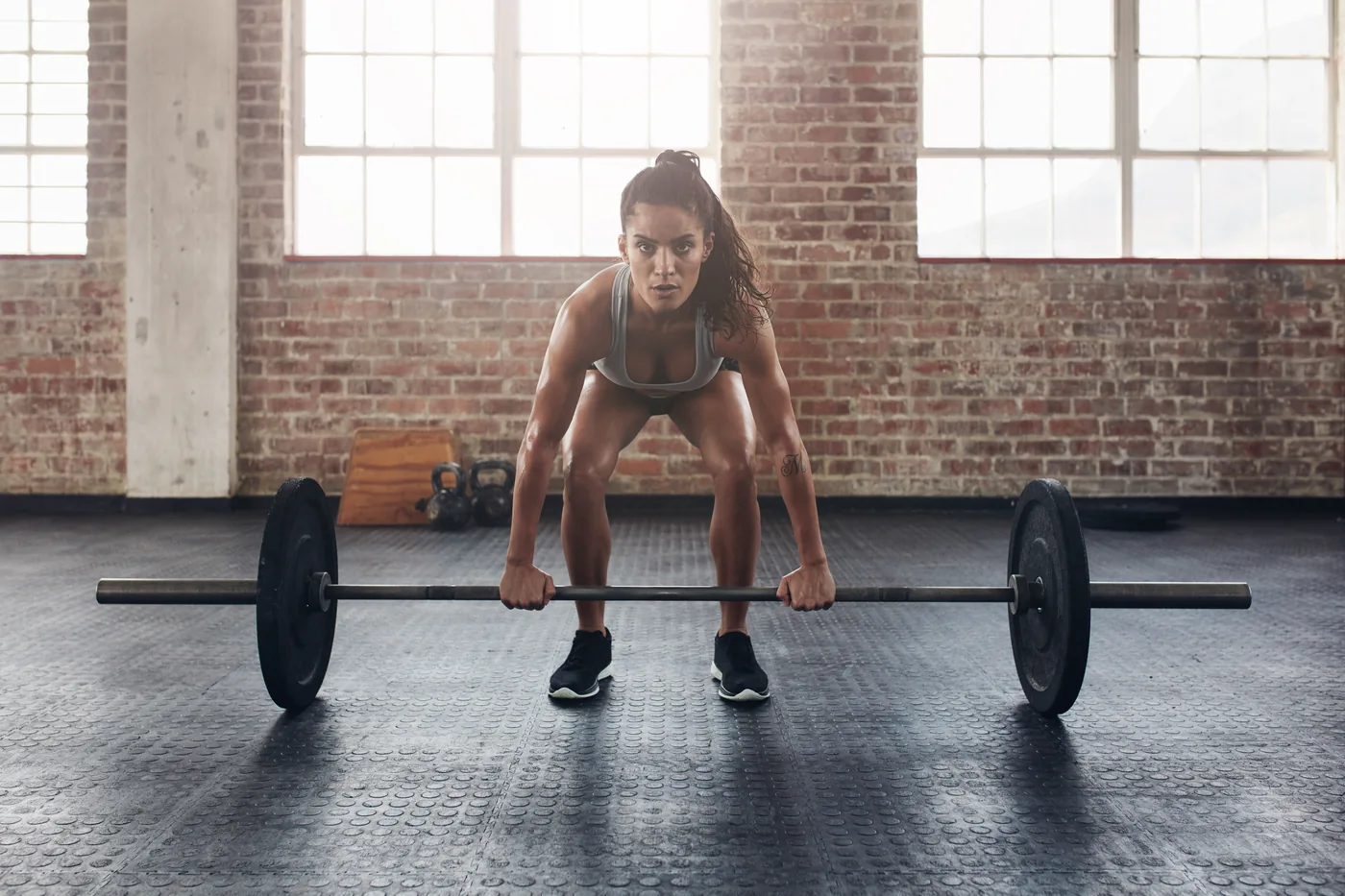
There is a corner of every gym that was, for decades, understood to be for women: the pastel dumbbells, two pounds, three pounds, five, light enough to carry on a fingertip. Generations of women were steered there by magazines, by trainers, by a culture that prized smallness, and were told that this was toning and that the racks of heavier iron across the room were for other people. It was always bad advice. In midlife it becomes advice worth actively unlearning, because the years when a woman is told to lift less are precisely the years her body is asking her to lift more.
What Midlife Asks of Muscle
Muscle is quietly time-sensitive. From roughly the mid thirties onward, adults who do not train lose it steadily, decade over decade, a slow leak so gradual it hides inside words like slowing down. Strength goes with it, and strength is not a gym statistic. It is the currency of ordinary life: the suitcase into the overhead bin, the grandchild onto the hip, the floor you can get up from without a hand, the fall that becomes a stumble instead of a broken wrist.
For women, the menopause transition raises the stakes. As estrogen declines, bone loss accelerates, and the years around the final period are when a woman's skeleton is most in motion. Muscle changes too; many women find that the training that used to maintain them no longer quite does. None of this is a verdict. All of it is information, and the information points one direction: the body in midlife responds to load, and it needs more of a reason to keep what it has.
Researchers who follow aging populations keep arriving at the same unglamorous markers. Grip strength, of all things, keeps showing up in long-running studies as one of the better single indicators of how a person's aging is going. Strength in midlife is not vanity. It is a deposit in the only account that matters at eighty.
The Fear That Kept the Weights Small
Ask a woman why she has never gone near the barbell and the answer, more often than not, involves the word bulky. It deserves a direct response: building conspicuous muscle is hard. It is the full-time project of people who train for it deliberately, eat for it deliberately, and are usually working with far more testosterone than a midlife woman has. It does not happen to anyone by accident, and it does not happen in two strength sessions a week. What happens in two sessions a week is subtler and better: firmness where there was softness, ease where there was strain, posture that reorganizes itself, a body that starts feeling like a capable instrument rather than a decoration under management.
The deeper unlearning is about what the weights are for. The pastel corner was built on the idea that exercise is how women earn smallness. Strength training runs on the opposite premise. You are not there to burn yourself smaller. You are there to build yourself stronger, and the change in premise changes how the whole room feels.
What Heavy Actually Means
Heavy is not a number. Heavy is a relationship between you and a weight, and the working definition is simple: a weight is heavy enough when the last two or three repetitions of a set of about six to ten require real effort and full attention, while your form holds. For one woman that is the bar alone. For another it is a pair of twenties. Both are lifting heavy, because heavy is measured against your own current strength and nothing else.
The reason effort matters is that muscle and bone are economists. They keep only what current demand justifies. A three-pound weight lifted thirty comfortable times tells the body that three pounds is the job, and the body keeps three pounds' worth of muscle. A genuinely challenging load tells it the job has changed. Then, as the load becomes manageable, it goes up a little, which is the entire secret of progress and the reason it is called progressive: the demand rises gently and forever, and the body keeps answering.
The movements that pay best are the boring, ancient ones: squatting down and standing up, hinging at the hips to pick something off the floor, pushing, pulling, carrying something heavy for distance. They earn their keep because they are the movements of actual life with the weight turned up.
Bone Hears It Too
Bone is living tissue, and it remodels itself all life long in response to what is asked of it. What asks loudest is load: meaningful resistance, and impact, transmitted through the skeleton. Research in postmenopausal women has repeatedly associated progressive resistance training with better maintenance of bone density than gentle activity alone, and supervised heavy lifting has held up well in studies of women with low bone mass, which surprised people who had assumed fragility demanded featherweights. Walking is good and not sufficient; bones habituate to it early. The skeleton, like the muscle wrapped around it, keeps what the demand justifies.
This is stated as what the research keeps finding, not as a promise, and a woman who already carries a diagnosis of osteoporosis, or any condition that makes loading a question, should build her program with a clinician and a qualified trainer rather than a magazine. That is not a warning against lifting. In most cases it is a warning against guessing.
Starting Without Wrecking Yourself
Buy skill before weight. The first month is about learning shapes: the squat, the hinge, the press, the row. A few sessions with a competent coach, a beginners' strength class, or a slow patient start with light loads and honest attention will pay for itself for a decade. Soreness that fades in a day or two is normal at first. Sharp pain is not; that is a stop sign, and worth a professional's eyes.
Two days a week is a real program. Not a compromise, a program. Full body, a handful of movements, forty-five minutes. Consistency beats ambition so thoroughly it is barely a contest.
Track something. A note on the phone with the date, the movement, the weight, the reps. Watching the numbers climb, five pounds here, two reps there, is the most reliable motivation in fitness, because it is evidence, not exhortation.
Eat like it matters. Muscle is built from protein and rebuilt in rest. Midlife bodies are less forgiving of skipped meals and short nights than young ones were. The training is the signal; the kitchen and the bed are where the building happens.
Expect the strange pride. Somewhere around month two or three, a weight that once felt impossible goes up smoothly, and something shifts that is not physical. Women describe it in almost the same words, a specific, quiet astonishment: I did not know I could do that. It generalizes. That is the part nobody puts on the poster.
The Practice Underneath
Picking up heavy things is, in the end, a statement of intent about the second half of a life. It says: I plan to carry my own groceries at eighty. I plan to get off the floor without help. I plan to take up the space I take up. The pastel corner promised a smaller body. The barbell offers a bigger life, and it is sitting there, patient as iron, whenever you decide the advice you were given was never meant to serve you.



Loading comments…