
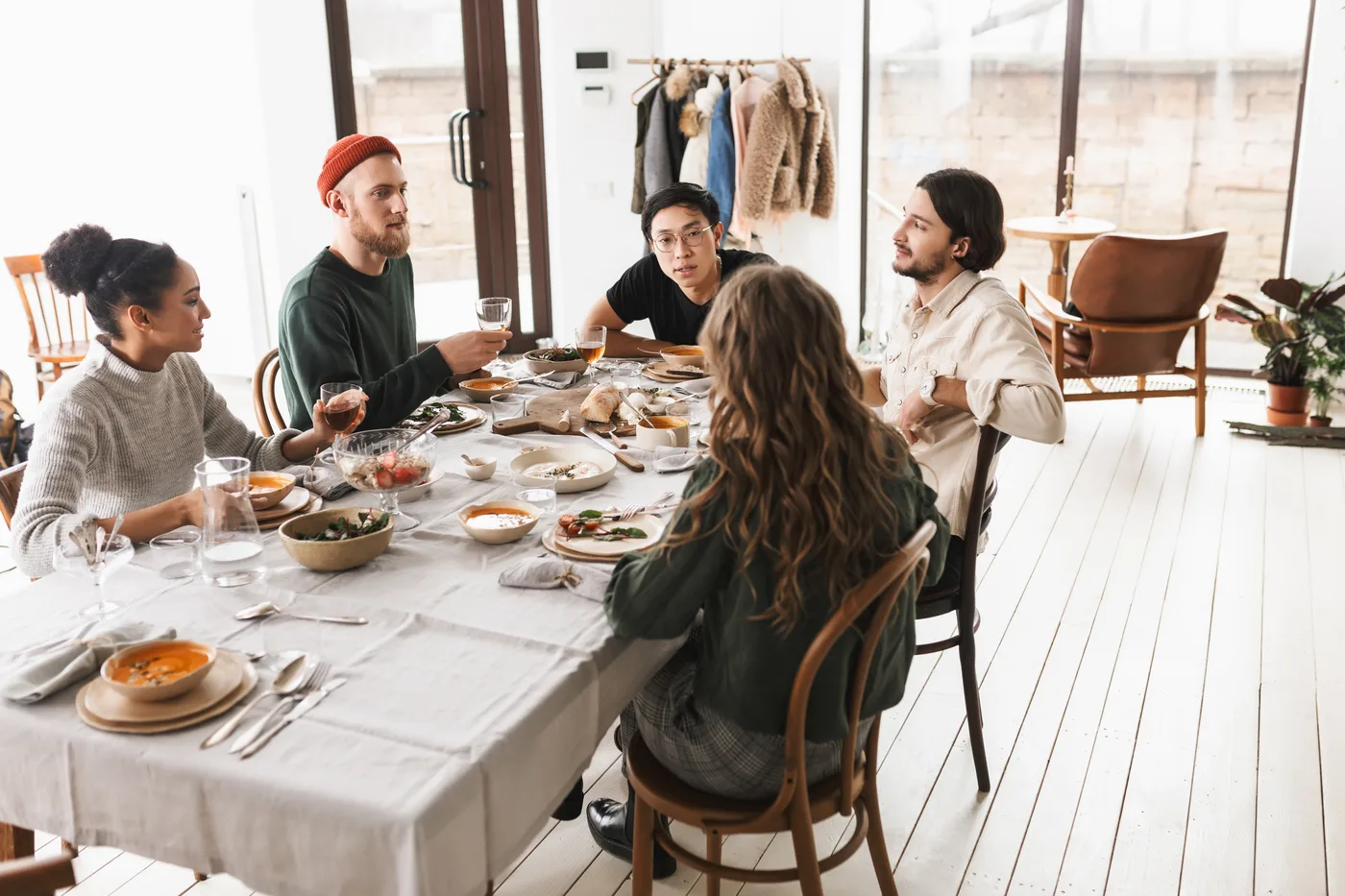
You know the hour. The guests are due at six, and at five the house becomes a crime scene you are scrubbing of evidence. Mail swept into a drawer. The good towels out, the real towels hidden. A candle lit to imply a household that always smells like this. And then the bell rings and you open the door already apologizing, excuse the mess, to people standing in a home tidier than it has been in three weeks. Everyone does some version of this, and everyone knows the stranger truth underneath it: the performance is exhausting enough that most of us have quietly stopped issuing the invitations at all.
Where the Company Went
Ask people when they last had friends over for an ordinary meal, not a birthday, not a holiday, just dinner because it was Tuesday, and the answers stretch back months, sometimes years. The affection is intact. The intention is intact; nearly everyone says they wish they did it more. What stands between the wish and the table is almost never the people. It is the production the evening has become in our heads: the menu that needs planning, the house that needs staging, the version of our life that needs to be assembled before anyone is allowed to look at it.
It is tempting to blame the calendar, and the calendar is guilty of plenty. But the same people who cannot find an evening to host will meet the same friends at a restaurant, which takes identical hours and costs five times as much. What the restaurant sells, at that price, is exemption: nobody's home is on display, so nobody's home can be judged. That we will pay so much to avoid being seen in our own kitchens says less about our schedules than about the standard we imagine we are being held to. A table in a home offers what no restaurant can: no bill arriving to end the conversation, no noise to shout over, and the peculiar intimacy of eating inside someone's actual life. We are not choosing restaurants because they are better. We are choosing them because they are safer, and the safety is the loss.
Somewhere along the way, having people over got confused with entertaining, and entertaining is a performance genre. It has sets, props and reviews. Hospitality is an older and humbler thing. It is making room for another person inside the life you are actually living, and its whole warmth comes from the fact that the life is actual. The two get spoken of as if they were the same activity, but they point in opposite directions. Entertaining asks what the guest will think of you. Hospitality asks whether the guest is comfortable, fed and glad to be there.
The Standard That Keeps the Door Shut
The staging instinct did not come from nowhere. We are marinated in images of other people's kitchens at their best angle, in lighting no kitchen has on a weeknight. The homes we scroll past have no drying rack, no permission slips on the counter, no dog hair drifting in the corner like tumbleweed. Measured against that, an ordinary Tuesday house feels like a confession, and so the bar for opening the door rises until the door mostly stays shut. The standard does not make anyone's home nicer. It just makes everyone's home lonelier.
Here is what the standard misses: your guest does not see your house the way you do. You see the baseboards because you live with the baseboards. Your guest sees a room they were invited into, a smell of food, a person who wanted their company on a random evening. Ask yourself what you actually remember from the last dinner at a friend's place. It is never the state of their stovetop. It is the laughing at the table, the second helping, the conversation that went one layer deeper than it does in a restaurant with a bill coming. Nobody has ever left a warm evening thinking mainly about dust.
The Gift of the Imperfect Table
There is something better than harmlessness in the unstaged house. A little visible reality is a form of generosity. When the home you welcome someone into is plainly lived in, you have handed them two gifts at once. The first is trust: they have been let backstage, treated as someone who does not require the show. Closeness is made of exactly this material. The second is permission: they can now invite you back without terror, because the standard you set was human. Immaculate hosting, whatever it intends, quietly raises the price of reciprocity. The friend who serves a perfect evening is a friend you hesitate to host in return.
This is how hospitality either compounds or collapses. High-production evenings are so costly that they happen twice a year, and the friendship lives on scraps in between. Low-production evenings can happen weekly, and the difference between seeing a friend twice a year and twice a month is not a detail. It is the difference between knowing about someone's life and being in it.
Lowering the Bar on Purpose
Shorten the runway. The killer of most invitations is the gap between impulse and event. If having people over requires two weeks of notice, the impulse dies in the calendar. Practice the short invitation: thought of on Tuesday, dinner on Thursday. The less lead time, the less staging anyone can attempt, which is the point.
Feed them simply, or not at all. One pot, one pan, or takeout served on your own plates. A soup and bread is a feast when the alternative was another evening apart. If cooking is the obstacle, drop it: people can be invited for tea, for cards, for an hour on the porch. The meal was never the reason anyone came.
Clean two things. The bathroom sink and the surface people will actually sit at. That is the whole list. This is not a decline into squalor; it is a decision about what an evening is for, made in advance, so the frantic hour at five never begins.
Retire the apology. No excuse the mess at the door. The apology does not lower the temperature; it raises it, because it announces that appearances are being tracked tonight. Greet people with gladness instead. I am so glad you came does more for a room than an hour of vacuuming ever did.
Let people help. When a guest asks what they can do, give them a real job: the salad, the glasses, the stirring. A guest with a task stops being an audience and becomes part of the household for the evening, and the evening warms accordingly.
The Open Door
None of this is really about housekeeping. It is about what we think our friends are for, and what we imagine they are measuring. The evidence of every good evening you have ever had says they are not measuring anything. They came because being wanted somewhere on an ordinary night is one of the scarcest goods in adult life, and you had it to give. Somewhere in your phone is a person you keep meaning to see. The house is fine. Thursday is fine. Ask them.


Loading comments…