
There is a passage, somewhere in whatever you are learning, where it always goes wrong. The same four bars of the song. The same turn of the wrist on the backhand. The same sentence in the language you are studying, where your mouth trips over the third word every single time. You know exactly where it is. And almost certainly, every time you reach it, you do what nearly everyone does: you take a breath, go at it at full speed, and hope this is the time it comes out clean.
It usually does not. And the reason it does not is worth understanding, because it applies to far more than music.
What you repeat is what you learn
A skill is not stored as an idea of how the thing should go. It is stored as a pattern of movement, a sequence your hands or your tongue or your feet have run enough times that they can run it without you supervising. That is the whole value of practice: it moves something from the deliberate part of your attention into the automatic part.
The difficulty is that the automatic part is not choosy. It learns whatever you hand it. If you play the hard passage at full speed and fumble it nine times out of ten, you are not practicing the passage. You are practicing the fumble, nine times, and the correct version once. The stumble becomes part of the pattern. That is why the mistake shows up in the same spot every time, as reliably as if it were written into the music. In a sense, by now, it is.
Musicians have known this for a long time, which is why a good teacher's first instruction for a trouble spot is almost always the same: slow it down. Not a little. A lot.
Finding the speed where it holds
Half speed is a useful starting rule because it is far slower than feels necessary. Most people, told to slow down, take ten percent off and call it slow. At ninety percent, the hands are still racing, still guessing, still reaching for the next note before they have finished the last one.
At half speed something changes. There is time to see what you are doing. You notice that the stumble is not really in the hard note at all, but in the note before it, where your hand arrives in the wrong position and has to scramble. You notice that your shoulder lifts at the same moment every time. You notice that you stop breathing. None of this is visible at full tempo, because at full tempo there is no room to notice anything.
The right speed is the fastest one at which you can do the thing correctly three times in a row without strain. If that turns out to be a third of the real tempo, that is the speed. There is no prize for starting faster, and there is a real cost, because every wrong repetition is one more vote for the version you are trying to get rid of.
Bringing it back up
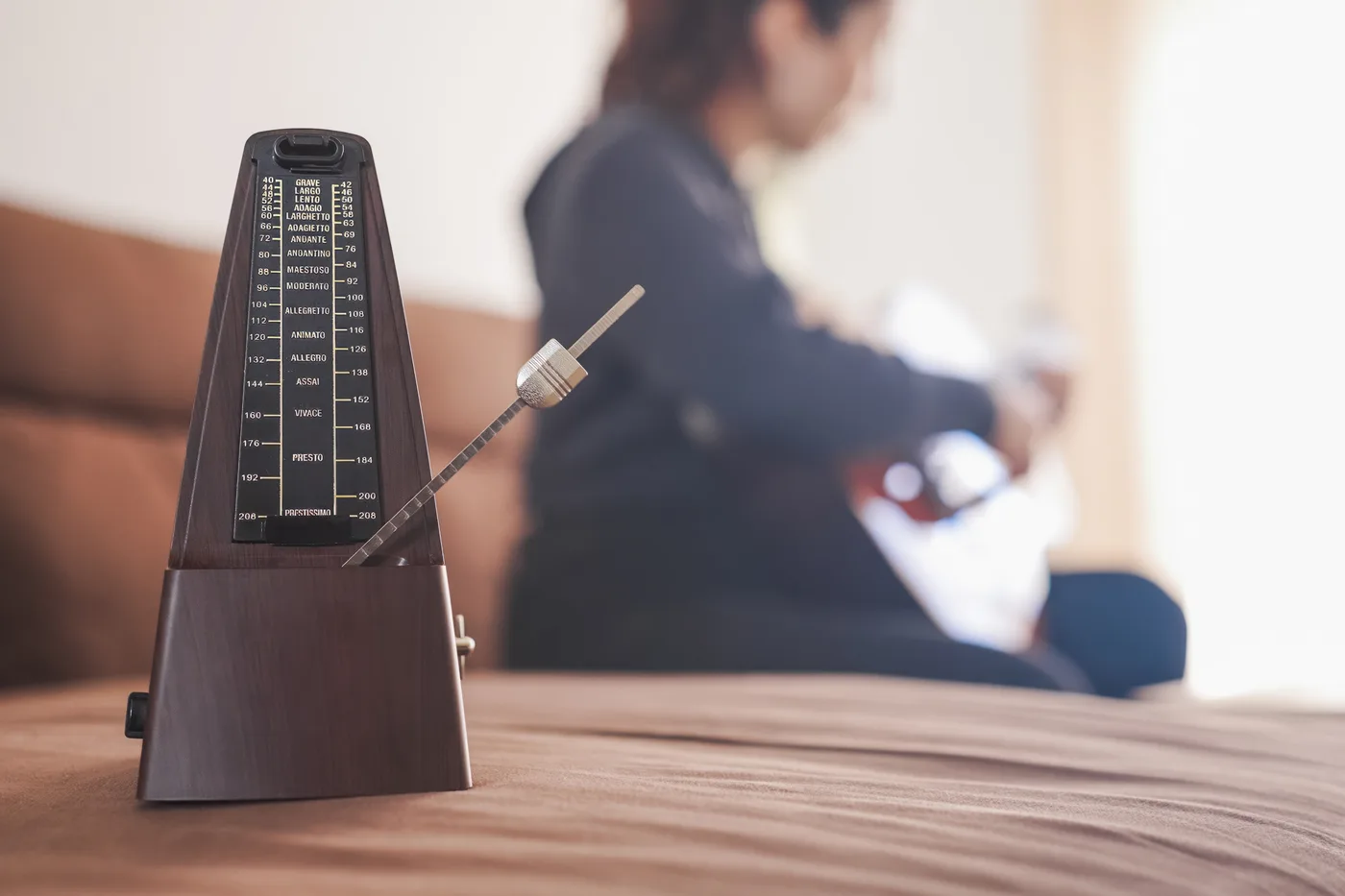
Once the passage is clean at the slow speed, you raise it a little. A metronome makes this precise, which is why it is the most useful cheap object a musician owns: a few clicks faster, three clean repetitions, a few clicks faster again. When it falls apart, and it will at some point, you go back down to the last speed where it held and spend a little more time there.
This feels painfully gradual, and for the first few sessions it is. Then something tends to happen that surprises people. The passage starts to arrive at speed on its own, sometimes in a day or two, and it arrives clean. The stumble is simply gone, because it was never rehearsed into the new version.
It is also common to find that the slow work does not show up until the next day. You can finish a session feeling as if nothing improved and sit down the following morning to find the passage noticeably easier. Skills seem to settle between sessions, not only during them, which is one more reason not to grind at a hard spot for an hour. Ten careful minutes, then leave it alone.
It is not only for music
The same principle holds almost anywhere a skill lives in the body or in a well-worn habit.
If you are learning to type properly, the keys you hesitate over are the ones to type slowly and correctly, not the ones to hammer at. If you are learning a language, say the difficult phrase slowly enough to get every sound right before you try it at conversational pace. In the kitchen, the knife cut that feels clumsy gets done slowly, with your attention on where the guiding hand sits, until it is safe and even, and only then faster. A golf swing, a tennis serve, a yoga transition, a signature in a new hand: the pattern is always the same.
It even applies to things that are not physical at all. A difficult conversation you keep having badly is, in a way, a passage you keep rushing. You hit the familiar trigger and go at full speed into the reply you always give. Slowing it down means pausing at exactly the point where it usually goes wrong, saying less, and taking longer before you answer. The first few times it feels awkward and stilted. That is what half speed feels like.
The patience it asks for
Slow practice is hard for a reason that has nothing to do with technique. It is humbling. It means playing your hardest passage at a speed a beginner could manage and accepting that this is, for now, your real level. Most adults would rather keep failing at full speed than succeed at a slow one, because failing at full speed at least looks like trying.
But the slow version is the honest one. It shows you exactly where the skill actually is, rather than where you wish it were, and it builds from there. There is a kind of relief in that, once you allow it. You stop fighting the passage and start studying it.
A week of half speed
Choose one thing you are working on, and inside it, one spot where it reliably goes wrong. Not the whole piece, not the whole skill, just the stretch of a few seconds where you always trip.
Each day this week, spend five or ten minutes on only that spot. Find the speed at which you can do it correctly three times running, even if it is embarrassingly slow. Stay there until it feels easy. Then nudge it up, and stop for the day while it is still going well, so the last thing you rehearsed is the clean version.
By the end of the week, try it at the real tempo once, without fuss. Whatever happens, notice where it holds and where it still wavers. That is next week's spot.
Getting faster, it turns out, is mostly a matter of being willing to go slowly for longer than feels reasonable. The speed comes from the clean repetitions, not the rushed ones.



Loading comments…