
Planetary Healing: Wholeness Beyond Pieces
by Alan Cohen, Hawaii
“Daddy, will you play with me?" was the last thing Bill wanted to hear from his five-year-old son. Bill had just come home from work feeling quite tired, and all he wanted to do was relax and read his magazine. Suddenly a scheme dawned on him. Bill cut a full-page photo of the Earth out of the magazine, tore it into a hundred little pieces, and handed them to his son. "Here is a jigsaw puzzle, Scottie," dad explained. "Take it to your room and put it together. When you are done, Daddy will play with you." Scottie enthusiastically ran off with the game, and Bill sat back smug and proud that he had bought himself a peaceful chunk of time.
To Bill’s surprise, Scottie returned ten minutes later with the entire picture intact. "How did you do that?" asked Bill incredulously; "I couldn't have done that puzzle in three times the time you took."
"The Earth picture you gave me was too complicated—there were so many pieces, and they all looked alike,” Scottie answered innocently. “So I turned over one of the pieces, and on it I saw the picture of a man's hand. I turned over another piece, and there was a foot. I turned over all the pieces, and it was easier to put one man together than the whole Earth. Then I discovered that when the man came together, so did the earth!”
As we enter Spring, our thoughts turn to rebirth and the preciousness of life. Yet we may feel daunted as we consider the abuse that humanity has inflicted upon the planet, compounded by social and political inequities. If you are reading Creations Magazine, you likely yearn to make a difference and somehow contribute to the healing of our world. But how?
The answer is quite simple, but requires consistent, dedicated inner work. Each of us must heal our own mind by dismantling fear, judgment, and misperception. James Allen said, “We think in secret, and it comes to pass. Environment is our looking glass.” While it may be tempting to seek to change other people and external conditions, the first step to planetary transformation is to find unassailable wholeness within ourself. When we see clearly and we are motivated by higher vision rather than fear, we will know exactly what to do to contribute to the well-being that eludes us around us, but awaits within us.
A Course in Miracles asks, “Can the world be saved if you not?” The Course is not referring to a religious conversion, but a return to the sanity that we have all drifted away from. The success of any endeavor depends on our motivation and attitude. Ram Dass used to say, “If you are protesting with anger, you are sending out a set of vibrations that are causing destruction.” Gandhi said, “In a gentle way you can shake the world.” When Mother Theresa was invited to speak at an anti-war rally, she declined, explaining, “Fighting war is just another form of war. If this was a pro-peace rally, I would gladly attend” I have also heard, “Fighting for peace is like screaming for silence.”
I have observed two different kinds of ecology: fear-based ecology and vision-based ecology. After watching countless ecology documentaries, I notice that many of them are fear-based. They focus almost entirely on the ecological horrors humanity has created, like birds and sea animals dying in oil spills, massive pollution over cities, devastation wrought by climate change, horrid factory farming, illness induced by chemical-infused foods, and more. The goal of these films is to shock viewers and frighten them into change. There is a certain value in this, to awaken people who are asleep. Yet fear is a very crude motivator. It’s perhaps a first step, but not the ultimate tool or goal. Frightening people into healing is simply perpetuating the fear and ignorance that led to the need for healing. Many such documentaries spend 85 minutes splashing gory scenes before viewers, and then five minutes on “Here’s what you can do to help.”
Vision-based ecology, on the other hand, is aware that change is called for, and focuses on models of how good it could get if we move in a new direction. I love watching documentaries about people who are turning city slum lots into community gardens; replacing farmlands depleted of nutrients with nitrogen-fixing crops; and patients who heal from cancer by adopting an organic diet. One of my favorite organizations, flashforest www.flashforest.ca generates massive reforestation by dispatching drones that drop a billion tree seedlings into mountain areas that have been clear-cut or burnt down. Vision-based organizations do not push against, but push for. We always get more of whatever we focus on. Focus on the problem, and get more of the problem. Focus on the solution, and the solution becomes real in our experience.
Personal integrity is the foundation of world transformation. I may not be able to stop wars between nations, but I can cease fire in the war against my ex-partner. I may not be able to feed all the hungry children, but I can end my own soul starvation. I may not be able to personally resolve environmental pollution, but I can purify my mind of attack and victim thoughts. Clarity begins at home. Then I am in the optimal position to know how to help others, and follow up with effective action.
Any person of conscience yearns to create a better world. We all have access to deep inner guidance that shows us our role to achieve that. All genuine healing occurs from the inside out. The metaphysical master Pierre Teilhard de Chardin put this sacred dynamic most succinctly:
“Someday, after mastering the winds, the waves, the tides and gravity, we shall harness for God the energies of love. And then, for a second time in the history of the world, man will have discovered fire.”
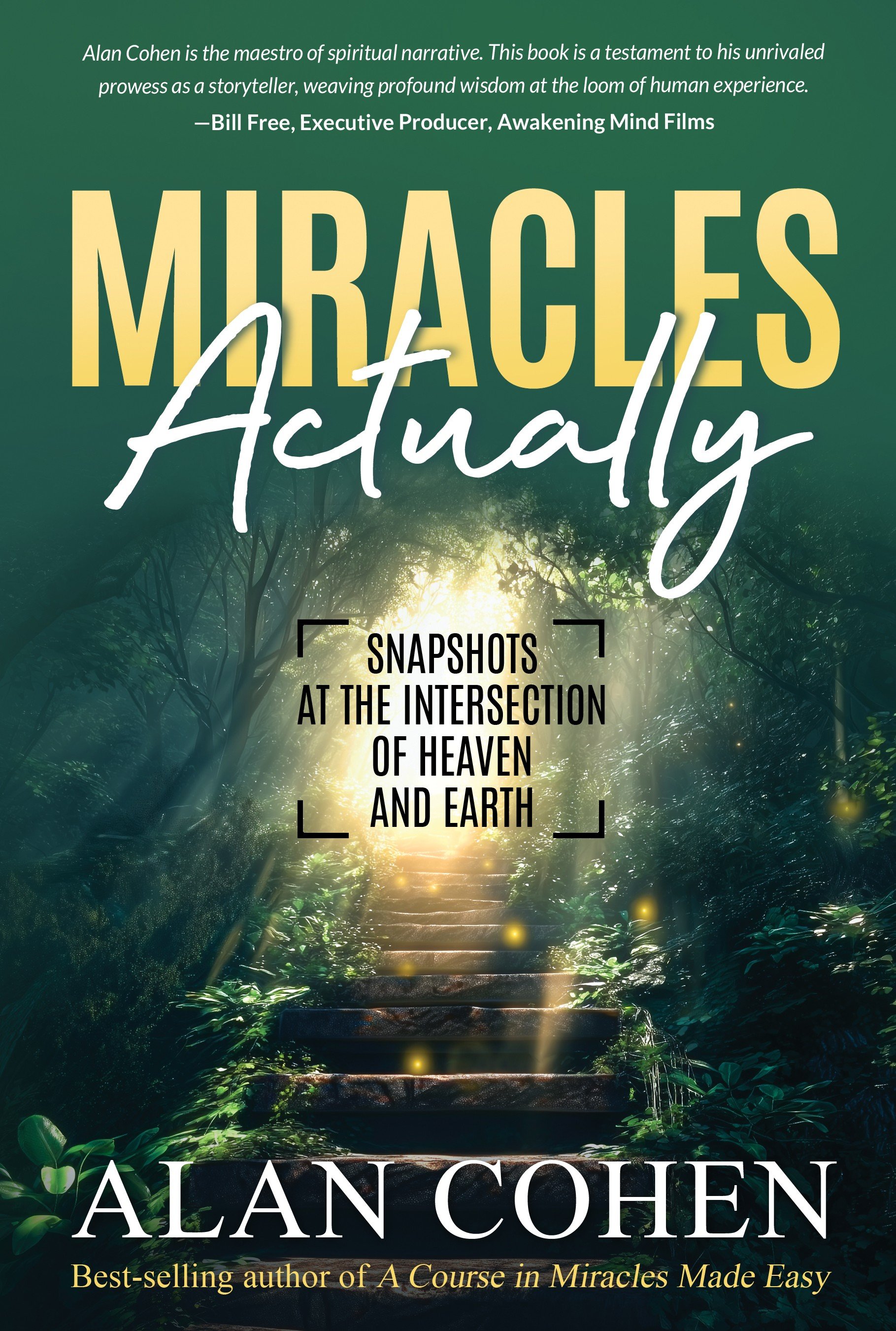
Alan Cohen is the author of the new best-seller Miracles Actually. Join Alan for his online training for holistic healers, “Be Whole Now,” beginning May 5. For information on this program, Alan’s books, weekly online Miracle Room, webinars, YouTube channel, free daily inspirational quotes, and Holistic Life Coach Training, visit www.alancohen.com.
